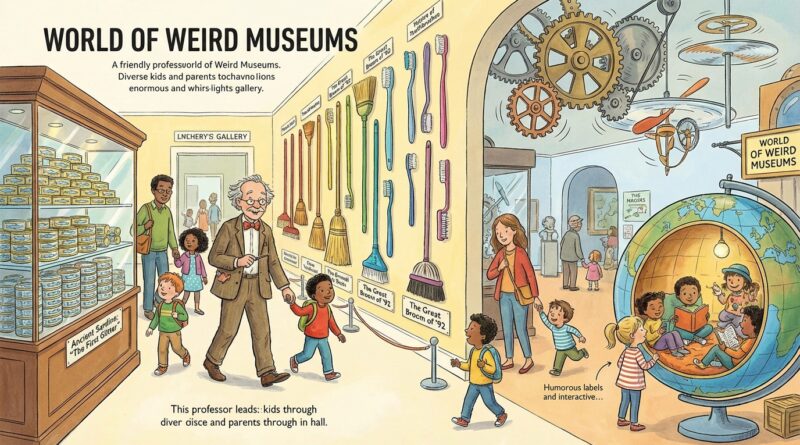
Around the World in Weird Museums: The Strangest Family-Friendly Collections on Earth
If your kids can name every dinosaur but somehow go glassy-eyed the second a history lesson starts, you are not alone. A lot of family “educational” content feels like homework with better lighting. That is why weird museums for kids and families can be such a gift. They take the pressure off. Instead of forcing interest, they spark it. A museum about canned fish, dust, bad art, or tiny objects sounds silly at first. Then everyone starts asking questions. Why would someone collect this? Who decided it mattered? What does it say about daily life? That is the sweet spot for family learning. It feels like a side quest, not a lecture. Better still, many of these oddball museums have photos, online exhibits, or short videos, so they work as quick virtual field trips at home and as real travel ideas later. Weird is not a distraction here. Weird is the hook.
⚡ In a Hurry? Key Takeaways
- Weird museums for kids and families often work better than standard history topics because they start with surprise and curiosity.
- Pick museums with strong visuals, one clear theme, and a built-in question your child can answer after five minutes.
- Most are family-safe if parents preview them first, but always check photos and exhibit descriptions for age fit.
Why strange museums work so well with kids
Kids are natural collectors. Rocks, stickers, weird leaves, bottle caps, toy parts. They already understand the basic idea of a museum, even if they do not use that word for it.
So when they hear there is a real place devoted to noodles, hair, salt and pepper shakers, or everyday objects, they get it immediately. It feels human. It feels funny. And it feels reachable.
That matters because a lot of classic history stories come pre-loaded with school energy. Important, yes. Exciting, not always. Odd museums sneak past that resistance. They let children start with “Wait, that is real?” Then the learning follows.
What makes a museum “family-friendly weird”
Not every unusual museum is a good pick for younger kids. Some are better for teens. Some are too graphic. Some are fun in person but dull online. A good family option usually has three things.
A clear hook
The best weird museums can be summed up in one sentence. “This museum is about everyday stuff people usually ignore.” “This one is about anchovies.” “This one collects miniature things.” If the concept is simple, kids can jump in fast.
Strong visuals
Children do not need a long wall of text. They need photos, objects, colors, odd labels, and things that look unlike what they saw five minutes ago.
Low-stakes learning
The goal is not mastery. The goal is one memorable fact, one laugh, and one follow-up question. That is enough.
Strangest family-friendly collections worth exploring
Museum of Everyday Life, Vermont, USA
This one may be the perfect example of weird museums for kids and families. The whole point is that ordinary objects are not boring once someone stops to really look at them. A display of safety pins, toothbrushes, or mirrors can start surprisingly big conversations. Who invented this? What did people use before it existed? What objects from our house would belong in a museum 100 years from now?
It is excellent for kids because it teaches observation without making a big speech about observation.
Anchovy Museum, Cetara, Italy
Yes, an anchovy museum. Which is exactly why children will remember it. Museums like this are gold because they connect food, local history, jobs, geography, and family traditions in one small package. Even picky eaters usually perk up when a tiny fish has an entire museum.
For parents, it is an easy way to talk about coastal towns, trade, preservation, and why certain foods matter so much in certain places.
The Meguro Parasitological Museum, Tokyo, Japan
This is one to preview first, especially for squeamish kids. But for older children who love gross facts, it is unforgettable. Parasites sound like pure shock value, but the museum also opens the door to real science. Life cycles. Human health. Animal biology. Why washing hands matters. Why cooking food properly matters.
For the right age group, this is “eww” with educational benefits.
Instant Ramen Museum, Osaka area, Japan
Few things grab kids faster than a museum devoted to a food they recognize. This kind of museum works because it takes a simple object and shows the invention story behind it. Suddenly lunch has a backstory. Children love that switch. Ordinary object. Secret history.
Museum of Bad Art, USA
This is a great choice for families who have kids nervous about doing things “right.” The joke is obvious, but the deeper point is useful. Not every creative attempt has to be perfect to be interesting. That can be a freeing message for children who love to draw, paint, or build but shut down when they think they are not good enough.
Mini Bottle Gallery or miniature-focused collections
Tiny things have a built-in advantage. Kids love scale. If it is normal-sized but tiny, they are in. Miniature collections are especially good for short attention spans because each object is quick to grasp. It takes only seconds to say, “That is a tiny chair,” and then start imagining who used it, why it was made, and how small something can get before it stops being useful.
How to turn a weird museum into a great 15-minute family activity
You do not need a full lesson plan. In fact, that can ruin it. Keep it light.
Start with one question
Try, “Why would anyone make a museum about this?” That gets kids thinking like curators instead of passive viewers.
Let them pick the weirdest item
Ask each person to choose one object that deserves to be famous and explain why. You will get better answers than you expect.
Connect it to home
After looking at the Museum of Everyday Life, have your child pick three ordinary objects at home that belong in your own mini museum. This works brilliantly because it makes the whole house feel more interesting.
Stop before attention drops
Short is fine. Better, actually. A ten-minute museum visit that ends with laughter is more valuable than a forty-minute slog that feels forced.
Good options for different ages
Ages 4 to 7
Go for food museums, miniature collections, toy collections, or anything with strong colors and simple categories. Keep the facts tiny. “This is a whole museum about one fish” is enough.
Ages 8 to 12
This is peak weird museum age. Kids in this group love bizarre facts, strange jobs, unusual collections, and anything they can retell later at dinner. Everyday objects, odd inventions, and quirky local history all work well.
Teens
Older kids can handle museums with more science, social history, or irony. This is where niche collections really shine, especially if they reveal how people decide what is important enough to preserve.
How parents can avoid the usual museum trap
The trap is trying to squeeze every last drop of education out of the experience. Resist that urge.
If your child remembers only that there is a real anchovy museum in Italy, that is still a win. Why? Because now they know museums are not just for kings, wars, and giant paintings. Museums can be about daily life, local food, overlooked objects, and odd human passions. That is a bigger lesson than it sounds.
It also gives families better screen time. Not louder screen time. Better. Screen time with a beginning, middle, and one interesting thing to talk about after.
Easy ways to find more weird museums for kids and families
Search by object, not by place. “Museum of bread.” “Museum of miniatures.” “Museum of everyday objects.” “Food museum for kids.” That tends to uncover more surprising places than generic travel searches.
When you find one, check the museum’s own website or social pages first. Small museums are often charmingly low-budget, which is part of the fun, but that also means hours and exhibit details can change.
And always preview anything biological, medical, or body-related before sharing it with younger children.
At a Glance: Comparison
| Feature/Aspect | Details | Verdict |
|---|---|---|
| Best hook for kids | Museums built around one odd object or theme, like anchovies, miniatures, or everyday items | Best for instant curiosity |
| Best use at home | Short virtual visits paired with one question and one follow-up activity | Great low-effort family screen time |
| Safety and age fit | Most are fine for families, but science or body-themed museums should be previewed first | Parent check recommended |
Conclusion
You do not need another fight over “educational” screen time. Sometimes all it takes is one delightfully odd museum to change the mood. Weird museums for kids and families work because they feel fresh, short, surprising, and safe enough to enjoy together. They give parents easy conversation starters, simple virtual field trips, and future travel ideas without the heavy school vibe. Whether it is the Museum of Everyday Life, the Anchovy Museum, or another tiny collection devoted to something wonderfully specific, these places remind kids that learning can start with a laugh. And honestly, that is often when it sticks best.