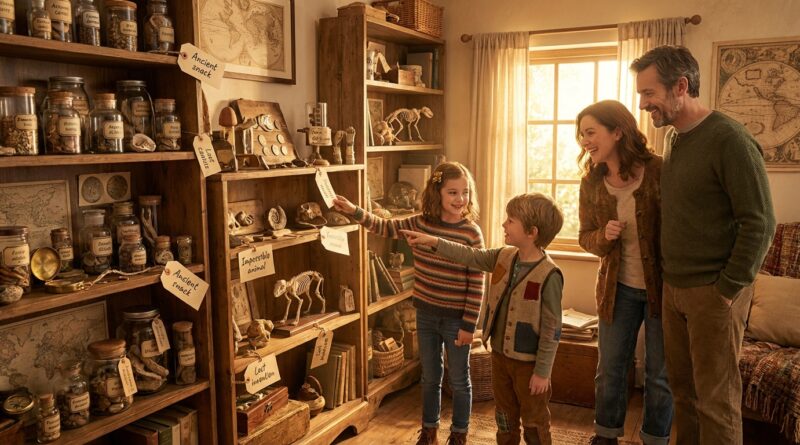
Build Your Own Mini Museum Of Weird History: How Cabinets Of Curiosities Turn Kids Into Curious Grown‑Ups
You know the moment. Your child lights up at dinner and says, “Did you know people once used leeches for medicine?” Then five minutes later it is mummies, plague masks, Roman concrete, and a two-headed calf from a county fair somewhere in 1893. It is fun. It is also chaos. The facts are fascinating, but they vanish as fast as they arrive. If you want that weird-history energy to turn into something deeper, a cabinet of curiosities for kids is a wonderfully low-tech fix. You are not building a formal museum. You are giving strange stories a home. A shelf, a shadow box, a jar of labeled finds, a printed picture of an odd artifact, a handwritten card with the tale behind it. That simple setup helps kids slow down, ask better questions, remember what they learned, and share it with the rest of the family without sounding like a human trivia app.
⚡ In a Hurry? Key Takeaways
- A cabinet of curiosities for kids turns random weird facts into a hands-on family project kids remember.
- Start small with one shelf, 5 to 10 objects or images, and short labels that answer what it is, why it matters, and what is still unknown.
- Use copies, photos, thrifted objects, and nature finds. You do not need expensive antiques, and you should avoid unsafe or fragile items.
Why this works better than another weird-history video
Kids are great at collecting facts. They are not always great at organizing them. Honestly, most adults are not either.
A physical collection changes the game. When a child picks one object, prints one image, writes one label, and places it in a real spot, the story sticks. It stops being “some thing I saw once” and starts becoming “the tale of this object and why it matters.”
That is the hidden power of a home mini-museum. It teaches research without feeling like homework. It teaches storytelling without a lecture. And it gives all those weird facts some walls and shelves to live on.
What a cabinet of curiosities for kids actually is
Forget the fancy phrase for a second. This is just a collection of unusual things and unusual stories, displayed with care.
Historically, cabinets of curiosities were rooms or cabinets filled with natural oddities, scientific tools, rare finds, fossils, maps, and objects from faraway places. Some were brilliant. Some were messy. Some mixed real science with wild misunderstandings.
That is part of the fun for kids. A modern version can include all kinds of things:
- A shark tooth from a gift shop with a note about how fossil hunting works
- A replica coin from ancient Rome
- A photo of a Victorian mourning brooch
- A feather, shell, or unusual seed pod from a family walk
- A printout of a medieval doodle from a manuscript margin
- A tiny jar labeled with “old cures people believed in” and a card explaining why they were wrong
The key is not rarity. The key is the story.
How to start without turning your house into a dusty junk shop
Pick one small home base
Start with a single shelf, tray, bookcase cubby, or wall-mounted shadow box. If you begin with the whole playroom, you will burn out by Saturday.
A good starter rule is this. If it cannot fit in one defined space, it does not go in yet.
Choose a theme for the first round
The best collections are focused enough to feel exciting, but broad enough that kids do not get bored. Good starter themes include:
- Strange medical history
- Odd objects people carried every day
- Weird animals people once misunderstood
- Lost jobs from the past
- Ancient tools and inventions
- Mysteries historians still argue about
A theme gives kids a lane. Otherwise they jump from pirate hooks to dinosaur poop to cold-war spy gadgets and nobody knows what goes where.
Use the “one object, three questions” method
For every item, ask:
- What is it?
- Why did people use it, fear it, or care about it?
- What do we still not know, or what did people get wrong at the time?
That last question matters. It quietly teaches critical thinking. History is not just a pile of facts. It is also people making guesses, mistakes, discoveries, and sometimes very bad choices.
The easiest items to collect
You do not need museum money. You need a printer, some curiosity, and maybe a glue stick.
Safe real-world objects
- Rocks, shells, feathers, seed pods, and fossils from reputable shops
- Replica coins, maps, seals, and tiny models
- Postcards or prints of odd artifacts from public domain museum collections
- Thrifted magnifying glasses, compasses, or small boxes
- Tickets, labels, and brochures from museum visits or historic sites
Printed “stand-ins” count too
This is important. Your child does not need a real medieval shoe buckle to learn from one. A printed image with a smart label works beautifully.
In some ways, it works better. Kids can compare pictures, mark them up, and build sets. “Three strange helmets through history” is often more useful than one random old object with no context.
Family-made artifacts
Some of the best items are homemade. Try clay tablets, copied wax seals, hand-drawn diagrams, or a “mystery specimen” jar filled with modern objects that mimic old collections.
The goal is not perfect authenticity. The goal is attention.
How to make the labels the secret learning tool
Kids love collecting. The labels are where the real magic happens.
Keep them short. A good museum card for children has four parts:
- Name: What the item is called
- Date or era: When it comes from
- Weird fact: The hook that makes people lean in
- Question: One thing we still wonder about
Example:
Plague Doctor Mask
1600s to 1700s, Europe
People believed the beak could hold sweet-smelling herbs to block disease.
Question: Did the outfit protect doctors at all, or mainly make them feel safer?
That last line gets kids out of “memorize and repeat” mode. It asks them to think.
Teach research without making it feel like school
If your child already loves blurting out weird facts, you are halfway there. You just need a simple process.
Use trusted sources first
Start with museum sites, library books, children’s history books, and university pages. Weird history is catnip for exaggeration. If something sounds too perfect, too gross, or too neat, check it twice.
Give them a tiny research checklist
- Where did you find this fact?
- Can you find it in two places?
- Is it a true object, a legend, or a mix of both?
- What was life actually like at the time?
This is one of the best things about a cabinet of curiosities for kids. It turns “Whoa, that is crazy” into “Wait, is that really true?” That is a grown-up skill hiding inside a fun hobby.
Make it a family ritual, not just another craft project
The families who stick with this usually do one simple thing. They make it recurring.
Try one of these:
- Curiosity Sunday: Add one new item each week
- Dinner museum minute: One child presents one label
- Mystery object night: Everyone guesses before the story is revealed
- Field trip follow-up: Add one item after every museum or historic-site visit
That rhythm matters more than perfection. Kids do not need a beautiful display worthy of a design magazine. They need a project that keeps asking them to notice, sort, explain, and wonder.
How to keep it from becoming clutter
This is where parents get nervous, and fair enough.
Use a “rotate, retire, archive” system
Display only a handful of items at once. Store older cards and pictures in a binder or portfolio. If something no longer fits the theme, retire it. If an item breaks or loses meaning, let it go.
You are building a mini-museum, not opening a storage unit.
Give every item a job
If an object does not teach a story, show a contrast, or spark a question, it probably does not belong in the main display.
This one rule keeps the collection thoughtful instead of random.
Safety rules worth keeping in plain view
Weird history can get, well, weird. Keep the collection kid-friendly and common-sense safe.
- Avoid real medical waste, chemicals, taxidermy of uncertain origin, sharp antiques, and unlabeled minerals
- Be careful with lead, mercury, arsenic-green vintage items, and old paint
- Use replicas for weapons, surgical tools, and fragile objects
- Skip anything that could carry mold, pests, or unknown residue
- For younger kids, avoid choking hazards and glass jars within reach
If the object is “interesting” because it might poison somebody, that is not the kind of authenticity you need.
Good weird-history themes by age
Ages 5 to 8
Keep it visual and concrete. Focus on animals, explorers, old tools, unusual clothing, or “how people lived before fridges, cars, and electricity.” They love the comparison to daily life.
Ages 9 to 12
This is prime cabinet-of-curiosities age. They can handle mysteries, medical myths, ancient inventions, misunderstood creatures, and stories where historians changed their minds.
Teens
Let them build sharper themes. Propaganda, pseudoscience, forensic history, shipwrecks, codes, and hoaxes work very well. So do displays that compare what people believed then with what evidence says now.
What kids really learn from this, besides strange dinner conversation
Quite a lot, actually.
- How to sort information into categories
- How to tell a story with a beginning, middle, and end
- How to compare sources and spot shaky claims
- How to connect objects to real human lives
- How to present ideas clearly to other people
And there is another benefit parents notice fast. The cabinet gives children a calmer way to focus. Screens throw new weird facts at them nonstop. A shelf asks them to stay with one.
When the collection gets deeper, let kids become the curator
Once the basics are in place, hand over more control.
Ask your child to curate a mini-exhibit with a title, three items, and a one-minute tour. They can build “Cures That Did Not Cure,” “Animals People Once Feared for the Wrong Reasons,” or “Tiny Tools That Changed History.”
This is where the project starts shaping curious grown-ups. They are no longer just collecting facts. They are deciding what matters, what belongs together, and what story the evidence tells.
At a Glance: Comparison
| Feature/Aspect | Details | Verdict |
|---|---|---|
| Cost | Can start with a shelf, printouts, labels, and thrifted containers. No rare antiques needed. | Budget-friendly and easy to scale |
| Learning Value | Builds research, memory, storytelling, and critical thinking through hands-on collecting. | Excellent for long-term learning |
| Parent Effort | Low at first if you keep it small and use a weekly routine. Higher if you let it sprawl. | Very manageable with simple limits |
Conclusion
If your child is already obsessed with weird facts, you do not need to fight that. You just need to give it shape. A cabinet of curiosities for kids turns scattered fascination into a shared family project with real staying power. It slows the scroll, gives strange stories a physical home, and helps kids practice research, storytelling, and critical thinking almost by accident. Right now a lot of families are drowning in random reels of bizarre history while incredible true stories flash by in seconds. A small shelf, a few labels, and one good question at a time can turn that noise into something memorable. Not just more facts, but deeper curiosity. And that is the kind that tends to stick.