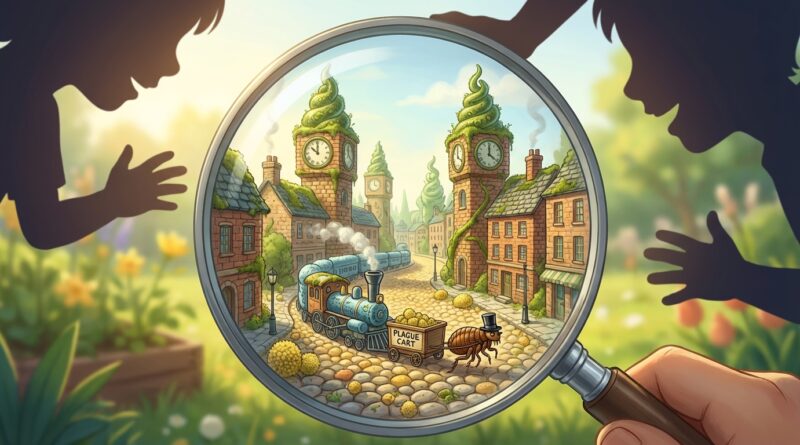
History’s Hidden Micro Monsters: The Tiny Creatures That Quietly Shaped Our World
If you have ever tried to wow a kid with history and watched their eyes glaze over by the third mention of a king, a war, or a giant stone building, you are not alone. Parents need fresh stories. The problem is that a lot of “fun history” keeps circling the same giant events and famous names. Meanwhile, some of the strangest, most powerful history stories are so tiny you cannot even see them. That is exactly why kids often love them. Fleas helped shake empires. Mold changed medicine. Mosquitoes messed with armies. Tiny sea life helped sailors, scientists, and explorers understand where they were and what kind of world they lived in. These weird historical facts about microscopic creatures for kids work because they make history feel close, surprising, and a little gross in the best possible way. Once children realize invisible life changed maps, battles, food, and health, ordinary places start to feel like detective scenes.
⚡ In a Hurry? Key Takeaways
- Microscopic creatures and tiny pests quietly changed major parts of human history, from disease outbreaks to medicine and exploration.
- To get kids interested, connect each tiny creature to a big human story they can picture, like a battlefield, a ship, or a loaf of bread.
- Keep the science kid-friendly and accurate. “Tiny” does not always mean harmless, and some museum stories can open useful talks about hygiene, health, and ecosystems.
Why tiny history stories hook kids faster
Big history can feel far away. Tiny history feels sneaky.
That is the magic here. A child may not care about a treaty signed in a fancy room. But tell them a disease-carrying flea rode around on rats and helped change Europe, and suddenly they are listening.
These stories work because kids can connect them to daily life. They know bug bites. They know mold on bread. They know germs make people sick. So when history starts with something familiar, the “wow” lands faster.
History’s hidden micro monsters
1. Fleas and the Black Death
Let’s start with the most famous tiny terror. In the 1300s, the Black Death killed millions of people across Europe, Asia, and North Africa. The disease was caused by a bacterium called Yersinia pestis. It spread in part through fleas that fed on infected rodents and then bit humans.
For kids, the story is wild because the chain is easy to picture. Rat. Flea. Bite. Illness. Whole towns changed.
The plague did more than make people sick. It changed jobs, money, and power. With so many people dead, workers became harder to replace. In some places that shifted wages and weakened old social systems. Tiny creature, huge ripple effect.
2. Mosquitoes that changed wars and empires
Mosquitoes are not microscopic, but what they carry is. Malaria parasites and viruses spread by mosquitoes have shaped battles, settlement patterns, and colonial plans for centuries.
Armies could be strong on paper and still fall apart from disease. In many tropical regions, invading forces faced a brutal reality. It was not just the local defenders they had to worry about. It was the insects.
That gives you a great history question for kids. What is stronger, a giant army or a tiny buzzing insect carrying a parasite? History’s answer is sometimes the insect.
3. Smallpox and the invisible enemy people feared most
Before vaccines, smallpox was one of the deadliest diseases on Earth. It was caused by a virus, far too small to see without powerful tools. It spread fast and left scars on many who survived.
Smallpox changed royal families, military campaigns, and entire populations. It also pushed people to search for better ways to prevent disease. That story leads straight to one of history’s biggest breakthroughs, vaccination.
This is a good spot to remind kids that science often starts with a scary problem. People were not studying germs just for fun. They were trying to survive.
4. Cowpox helped spark vaccines
Here is one of the most hopeful weird history stories. In the late 1700s, Edward Jenner noticed that milkmaids who had caught cowpox, a usually milder disease, seemed less likely to get smallpox. That observation helped lead to the first vaccine.
The details can be simplified for kids, but the big point matters. A tiny biological clue helped people fight one of history’s worst killers.
That is a useful lesson for children. Sometimes a world-changing idea starts by paying close attention to something small and odd.
5. Mold that changed medicine forever
One of the best “gross but amazing” stories is penicillin. In 1928, Alexander Fleming noticed that mold growing in a petri dish had killed bacteria nearby. That mold led to the development of penicillin, one of the first widely used antibiotics.
Kids love this story because it sounds like a messy accident, and in a way, it was. But it was also about noticing what others might ignore.
Before antibiotics, even small infections could become deadly. After them, medicine changed fast. A fuzzy patch of mold helped save millions of lives.
6. Yeast, the tiny helper behind bread and history
Not all hidden micro creatures were villains. Yeast is a microscopic fungus, and humans have used it for thousands of years to make bread rise and to brew drinks.
That may not sound dramatic at first, but food technology changes civilizations. Reliable bread matters. Fermentation matters. Tiny organisms helped people preserve, prepare, and improve everyday food long before they understood the science.
This is a nice way to show kids that microbes are not just “bad germs.” Some are helpers. A lot of life on Earth depends on them.
7. Tiny sea creatures that helped people read Earth’s past
Some microscopic organisms leave behind shells or traces that settle into ocean mud and rock. Much later, scientists can study those remains to learn about ancient climates, oceans, and changes in Earth’s history.
This matters because explorers and scientists did not just shape history with ships and maps. They also learned from tiny forms of life hidden in sediments and samples. Invisible life became part of how we figured out the visible world.
For museum visits, this is especially useful. If you see magnified plankton photos or displays about ocean cores, kids can connect them to a detective story about Earth’s past.
What makes these stories feel so fresh
They flip the usual scale of history.
We are used to hearing that the biggest things matter most. The largest buildings. The most powerful rulers. The biggest battles. But weird historical facts about microscopic creatures for kids turn that upside down. They show that things too small to spot with your eyes can still crash economies, change medicine, or help build dinner.
That twist is what makes the topic stick.
How to talk about microscopic history without losing kids
Start with the gross factor
There is no shame in this. “A flea helped spread one of history’s deadliest diseases” is a much better opening line than “Today we will discuss medieval demographic shifts.”
Connect tiny life to one visible scene
Pick something a child can picture. A crowded city. A battlefield. A bakery. A ship. A hospital ward. Then add the tiny creature into that scene.
Use one big consequence
Do not dump five facts at once. Stick to one payoff. Example: mold led to penicillin. Mosquitoes weakened armies. Yeast helped make bread.
Let kids ask the obvious question
Usually it is, “How could something so tiny do that?” That question is the whole point. It opens the door to science without making it feel like homework.
Easy ways to turn this into a weekend activity
If your family is visiting a museum or science center, look for exhibits with microscopes, enlarged insect photos, germ displays, ocean samples, or fermentation topics. Then play a simple game. Ask, “What big human story might this tiny thing have changed?”
You can also do this at home.
- Look at bread dough and talk about yeast.
- Talk about why mosquito control matters.
- Use a magnifying glass in the yard and discuss how much life we usually miss.
- At the library, pair a plague or medicine book with a simple kids’ science book about germs.
The goal is not to run a class. It is to build curiosity.
One useful caution for parents
Because these stories involve disease, it helps to keep the tone curious instead of scary. Younger kids do not need every grim detail. They just need the core truth. Tiny organisms can help us, hurt us, and teach us a lot about how people lived in the past.
It is also worth pointing out that old history stories sometimes blamed the wrong people for outbreaks because they did not understand germs yet. That can lead to a thoughtful, age-appropriate talk about how better science helps us avoid bad guesses and unfair blame.
Why this topic matters right now
Museums and science centers are full of giant blown-up images of mites, pollen, plankton, fungi, and bacteria. Kids are already seeing the pictures. What is often missing is the story.
Once you add the story, those strange images stop being random science wallpaper. They become clues. That fuzzy thing helped create medicine. That biting insect changed military history. That tiny organism helped people make food for thousands of years.
At a Glance: Comparison
| Feature/Aspect | Details | Verdict |
|---|---|---|
| Best “wow” example | Fleas and plague show how a tiny creature helped drive a huge historical disaster. | Great for grabbing attention fast |
| Best hopeful example | Mold and cowpox connect small biological discoveries to vaccines and antibiotics. | Best for showing science can solve problems |
| Best everyday example | Yeast in bread helps kids see that microbes are part of normal life, not just scary diseases. | Best for hands-on family conversations |
Conclusion
When kids are tired of the same giant history stories, tiny life can open a much better door. Right now museums and science centers are leaning hard into microscopic exhibits and strange tiny-life photography, which means families are already bumping into this world but not always getting the story behind it. Once you connect those images to real turning points in history, you get something rare. A topic that is weird, memorable, scientific, and surprisingly human. It gives parents an easy way to spark curiosity, slip real history and science into a normal outing, and turn a walk through a museum into a hands-on hunt for the invisible creatures that quietly rewrote our world.