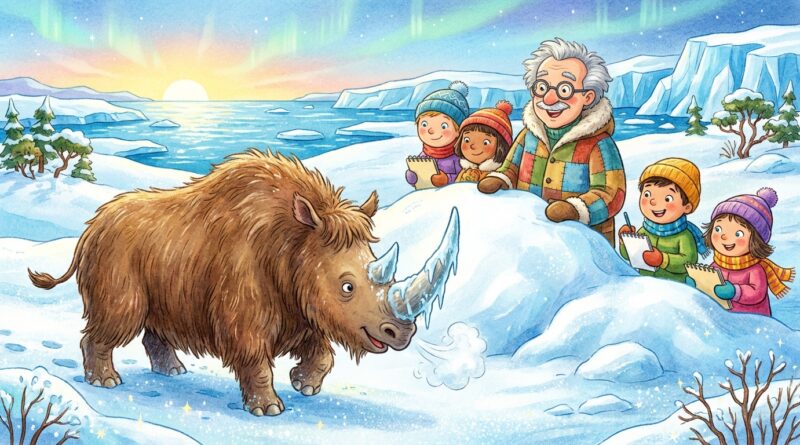
Rhinos in the Snow? The True Story of Ice Age Unicorns That Lived in the Arctic
If your kids are tired of the same old history facts, you are not imagining it. A lot of school-age science gets served like a dusty shelf of dates and names, even when the real story is far stranger. Case in point. Most children picture rhinos under a blazing sun and unicorns in made-up forests. Almost nobody tells them that real horned giants once lived far up in the Arctic. That sounds like a bedtime story mash-up, but it is real science. In the last day, researchers announced a newly identified species of rhinoceros that once roamed the Canadian High Arctic. That makes this one of those rare history stories that feels brand new, because it is. For parents and teachers hunting for surprising arctic history facts for kids, this is the good stuff. It turns prehistory from a memorizing exercise into a plot twist, and it shows children something important. Science is not finished. People are still figuring out Earth’s story right now.
⚡ In a Hurry? Key Takeaways
- Researchers say a newly identified rhinoceros species once lived in the Canadian High Arctic, which means rhino relatives survived in places many kids imagine as empty ice worlds.
- Use this story to help kids picture ancient Arctic environments as greener and warmer than today, not just frozen white deserts.
- This is a great example of how science changes with new evidence, so it is useful for teaching critical thinking, climate history, and extinction without making it feel scary.
Why this discovery grabs kids right away
There is a simple reason this story works so well. It breaks a picture kids already have in their heads.
Rhinos belong in hot places. The Arctic belongs to polar bears. That is the usual mental map. So when you tell a child that horned, rhino-like mammals once stomped around the far north, you get that wonderful pause. Wait. What?
That surprise is powerful. It opens the door to better questions. What did the Arctic look like back then? How did these animals survive? Why are they gone now?
Those are much better questions than “What year did this happen?”
So, were these actually unicorns?
Not in the fairy-tale sense. No sparkles. No magical healing powers. No rainbow gallop.
But they were real horned mammals, and some extinct rhino relatives have inspired the old “ice age unicorn” nickname because of their impressive horns and unusual look. That is part of what makes this story such a hit with families. It sounds like fantasy, but it is tied to fossils and research.
If you are talking to younger kids, a good way to put it is this: they were not storybook unicorns, but they were real ancient animals with giant horns, living in a place where most people would never expect to find them.
What the Arctic was like when these rhinos lived
Here is the part that often surprises adults too. The Arctic has not always looked the way it looks now.
Today, when people hear “High Arctic,” they imagine endless snow, ice, bitter winds, and almost no large land animals. But deep in the past, some Arctic regions were warmer and supported forests, plants, and enough food for big mammals.
That does not mean it was tropical. It means Earth’s climate has changed a lot over millions of years. The far north has gone through dramatic shifts.
Think of it like Earth changing outfits
Sometimes the planet wore an ice coat. Sometimes it wore something much milder. The land was still far north, but the conditions were different enough to support animals that would seem wildly out of place there now.
That idea helps kids understand a big truth without getting lost in jargon. Places are not locked into one climate forever.
How scientists know rhinos lived there
This is where the story becomes more than a fun headline.
Scientists do not just guess. They use fossil evidence. That can include bones, teeth, rock layers, and clues from the surrounding environment. The shape of a tooth can say a lot about what an animal ate. The age of the rocks helps place it in time. The location tells us where that animal once lived.
When researchers identify a newly recognized species, they are comparing details very carefully. They look at anatomy. They compare fossils with known species. They check whether the differences are big enough and consistent enough to show this was not just a variation of an already known animal.
Why fossils matter so much
Fossils are like puzzle pieces, but most of the puzzle is missing.
Scientists rarely find a complete, perfect skeleton waiting in the ground. More often, they find bits and clues. The work is slow. It takes comparison, testing, and debate. That is one reason this news is exciting. It is not just about a rhino. It is about how people figured out one more piece of the ancient world.
Why this counts as one of the best surprising arctic history facts for kids
Because it does three things at once.
First, it surprises them. Second, it is true. Third, it naturally leads into bigger ideas about climate, extinction, and how science works.
That is the sweet spot for family learning. You get the wow factor without having to make anything up.
It also fixes a common mix-up
Many kids picture the Arctic as a place that has always been frozen exactly the same way. This story helps correct that gently. Earth has a long history, and the world kids see today is just one chapter.
How to explain it to children without making it too complicated
You do not need a lecture. A few simple lines can do the job.
- “A long time ago, the Arctic was different from today.”
- “Scientists found evidence that a kind of rhinoceros lived there.”
- “That tells us big animals once survived much farther north than we expected.”
- “It also shows that science keeps changing when new evidence is found.”
That is enough to start. If the child wants more, then you can build from there.
Good follow-up questions to ask kids
- Why do you think a rhino could live there back then but not now?
- What would the Arctic need to have for a giant animal to survive there?
- How do you think scientists tell one species from another?
- What does this tell us about how Earth changes over time?
Those questions help children think like scientists, not just repeat facts.
What this teaches about climate and extinction
This is where the story gets even more useful.
Kids are already hearing about climate change, endangered animals, and extinction. Sometimes they hear those topics in a way that feels abstract or overwhelming. A story like this makes the ideas concrete.
It shows that climates have changed before, though for many different reasons across Earth’s long history. It shows that animal survival depends on habitat, food, and changing conditions. And it shows that species come and go, which is sad, but also part of understanding life on Earth.
The key is tone. You do not need to turn it into doom. You can keep it grounded and curious.
Try this: “Animals need the right home to survive. When the world changes, some adapt and some do not. That is one reason scientists study old fossils so carefully.”
Why parents and teachers should pay attention to stories like this
Because this is exactly the kind of science news that wakes kids up.
It is current. It is weird. It is real. And it proves that research is still moving. The textbook version of history can make it seem like everything worth knowing has already been found. That is not true at all.
New fossils, new scans, and new comparisons keep changing what we know. So when a child asks, “Are scientists still discovering things?” the answer is a very satisfying yes.
A nice bonus for reluctant readers
Stories with a built-in twist often work better than standard fact sheets. “Rhinos in the Arctic” is sticky. Children remember it because it clashes with what they expected.
And once they remember the surprise, they often remember the science too.
At a Glance: Comparison
| Feature/Aspect | Details | Verdict |
|---|---|---|
| Main surprise | A newly identified rhinoceros species once lived in the Canadian High Arctic. | Excellent hook for kids and adults. |
| What it teaches | The Arctic was not always the frozen landscape we picture today, and science updates with new evidence. | Strong fit for home or classroom learning. |
| Best use for families | Start conversations about fossils, climate, extinction, and how scientists solve mysteries. | One of the most memorable surprising arctic history facts for kids. |
Conclusion
This is the kind of discovery families should hang onto. In the last day, researchers announced a newly identified species of rhinoceros that once roamed the Canadian High Arctic, proof that huge, horned mammals survived in places kids today imagine as penguin-only ice deserts. That is not just a neat fact. It is a reminder that history and science are still moving, still changing, and still full of plot twists. For parents and teachers, that is gold. You get a true story that feels as thrilling as fantasy, while also opening the door to real conversations about climate, animals, fossils, and extinction. Best of all, kids get the feeling that they are hearing brand new science as it happens. That sense of discovery matters. It tells them the world is still full of mysteries, and there is still time to be the person who helps solve one.