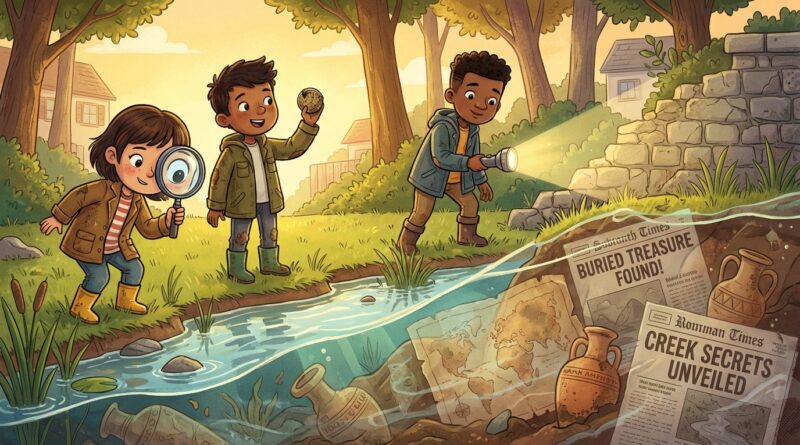
The Explorer’s Lost & Found: True Stories Of Kids Who Stumbled Onto History By Accident
You can only hear so many random “Did you know?” facts before your eyes glaze over. Parents feel that too. The problem is not that kids dislike history. It is that history often gets served like dry trivia, disconnected from real places, real people and real excitement. What sticks better are stories where ordinary kids make surprising historical discoveries made by kids, not because they were experts, but because they were curious, paying attention and willing to poke around a little.
That is the magic here. Some children have found ancient treasure, dinosaur tracks, valuable artifacts and clues to lost worlds just by walking a beach, digging in the yard or exploring on a family outing. These stories do more than entertain. They show kids that the ground under their sneakers has a past. Better yet, they give parents a simple way to turn a slow afternoon into a mini expedition. No expensive gear. No long lecture. Just a few true stories, a little caution and a fresh reason to get outside and look closely.
⚡ In a Hurry? Key Takeaways
- Kids really have made major historical and prehistoric discoveries by accident, from fossils to ancient treasure.
- You can turn that idea into a family adventure with neighborhood walks, creek checks, attic searches and a simple “what might this be?” challenge.
- The rule is simple. Look, photograph, ask experts if needed, and do not pocket protected artifacts or disturb unsafe sites.
Why these stories land so much better than “fun facts”
A fact is easy to forget. A story is harder to shake.
“A Roman coin was once found in Britain” is mildly interesting. “A child out walking spotted something shiny in the mud, and it turned out to be part of a real ancient find” is different. Now there is tension. Surprise. A setting you can picture. Suddenly history is not trapped in a museum case. It is underfoot.
That matters for families. Kids do not need a bigger pile of content. They need a reason to notice the world around them. True stories of accidental discovery give them that.
True stories of kids who stumbled onto history by accident
1. A boy found a Viking hoard while helping on a family farm
In England, a young boy named James Hyatt helped his dad clear a field. While using a metal detector, he found what turned out to be a major Anglo-Saxon and Viking-era hoard. Not a toy coin. Not junk metal. A real stash linked to a turbulent chapter of British history.
What makes this story work for kids is how normal it started. This was not an Indiana Jones setup. It was family time outdoors. Curiosity did the rest.
What kids can learn: big finds often begin with small attention. A beep. A glint. A strange shape in dirt.
2. A child discovered a mammoth tooth on a beach
Beachcombing already feels a bit like treasure hunting. Sometimes it actually is. In several well-documented cases around the world, children have found Ice Age remains, including mammoth bones and teeth, while walking shorelines with family.
To a child, it may first look like a weird rock. To a trained eye, it can be evidence of an animal that walked the earth thousands of years ago.
What kids can learn: ancient history is not just “old buildings.” It can be natural history too, sitting in cliffs, creeks and coastal erosion zones.
3. Dinosaur footprints have been spotted by kids on ordinary outings
Some of the most exciting fossil stories begin with a family walk. Children have helped spot footprints impressed in stone, especially in areas where erosion reveals new layers. A pattern that looks odd, too regular, too deep, can end up being part of a prehistoric trackway.
That is the fun part. A kid does not need to know everything. They just need to notice that something looks different.
What kids can learn: science and history both start with the same question. “Wait, what is that?”
4. A child in Israel found an ancient Egyptian scarab amulet
On a family trip, an eight-year-old girl picked up what looked like an ordinary stone. It turned out to be a 3,500-year-old Egyptian scarab amulet. That kind of discovery sounds impossible until you remember how many historic places still hold pieces of the past just below the surface.
This one is a great reminder that kids often notice what adults walk past.
What kids can learn: being observant is a superpower. You do not have to be older to spot something important.
5. Backyard digging has turned up old bottles, tools and forgotten local history
Not every discovery makes international news. Some of the best family finds are local. Old marbles. Hand-forged nails. Pottery shards. Glass bottles from businesses that no longer exist. Coins dropped generations ago.
These are not “lesser” discoveries. They can open a door to neighborhood history in a way no worksheet ever could. Who lived here? What stood on this lot before your house? Why does that creek bank keep turning up old brick and glass?
What all these stories have in common
They are not really about luck alone.
Yes, chance matters. But these discoveries usually happen because a child was in a place where looking was possible, and because they were paying attention. That is the part families can copy.
- They were outside.
- They were not rushing.
- They noticed odd details.
- An adult took the find seriously.
- Someone checked with experts instead of guessing.
That formula is more useful than any list of weird facts. It gives parents a repeatable way to build curiosity.
How to create your own “accidental explorer” day at home
Start with a tiny mission
Kids do better with a quest than with “go play outside.” Try one of these:
- Find three objects that look older than the street around them.
- Look for marks in stone, brick or tree roots that tell a story.
- Search the yard for signs of earlier building, gardening or dumping.
- Visit a creek or beach and hunt for the strangest rock shape.
- Walk one block slowly and ask, “What here would confuse someone 200 years from now?”
Use the phone as a tool, not the whole activity
This is where parents can win back some screen time without starting a fight. Let kids use a phone to photograph finds, record where they found them and compare shapes later. The device becomes a field notebook, not the main event.
A simple photo album called “Possible History” can be surprisingly effective.
Teach the golden rule. Don’t grab first
If something looks important, unusual or possibly protected, do not stuff it in a pocket. Take a picture. Note the location. Ask a local museum, park office, historical society or university department.
This is especially important for fossils, artifacts, burial areas, protected parkland and anything on private property that is not yours.
Make the follow-up part of the fun
The best moment is often not the finding. It is the “you won’t believe what that was” part a day later.
Email a photo to a local expert. Compare it with museum websites. Look up old maps of your neighborhood. Check whether your town once had a rail line, mill, quarry or farm on that spot.
That is when kids see history as a living puzzle instead of a closed book.
What parents should watch out for
Safety beats treasure every time
Skip abandoned buildings, unstable creek banks, construction sites and steep cliffs. Wear gloves if kids are handling old metal or glass. Wash hands afterward. And if you find anything that could be dangerous, including ammunition or chemical containers, leave it alone and call the right local authority.
Know the rules where you live
Metal detecting, digging and artifact collecting can be restricted in parks, beaches and archaeological areas. A quick check now saves a big headache later.
Manage expectations
Most Saturdays will not end with a Viking hoard. That is fine. The real win is training a child to notice, ask and investigate. If they come home excited about an old bottle stopper or a strange fossil-like stone, you are already doing it right.
Easy prompts that get kids thinking like explorers
If your child says, “This is boring,” try one of these questions:
- What is the oldest thing you can see from where you are standing?
- What looks out of place here?
- If this sidewalk could talk, what would it say?
- What might be buried nearby that tells a story about this area?
- What would an archaeologist 500 years from now think this place was for?
Those questions work because they turn observation into imagination, then imagination into investigation.
Why kids remember this stuff
Because they were part of it.
That is the missing piece in so much educational content. Kids remember what they touch, spot, ask about and retell later at dinner. They remember the shell that looked like a claw, the old bottle found by the fence, the weird mark in the rock that maybe was nothing, until someone explained it.
Even when the “discovery” turns out to be ordinary, the process is not. It teaches patience, close looking and respect for evidence. Those are solid habits whether your child grows up to be a historian, a coder, a mechanic or none of the above.
At a Glance: Comparison
| Feature/Aspect | Details | Verdict |
|---|---|---|
| Kid appeal | Real stories of children finding fossils, treasure and artifacts feel like adventure, not homework. | High. Much stickier than random fact lists. |
| Parent effort | Needs only a short walk, a backyard search, a creek visit or a phone for photos and notes. | Low to moderate. Easy to try on a weekend. |
| Educational value | Builds observation, patience, local history knowledge and respect for proper identification and safety. | Excellent. Fun with real-world learning built in. |
Conclusion
The best part of these surprising historical discoveries made by kids is not just that they happened. It is that they make kids think, “Maybe I could find something too.” That feeling is powerful. Today’s feeds are packed with quick oddball facts that vanish as fast as they arrive, but families want something better. They want curiosity that lasts longer than a swipe. A simple walk, a careful look at a creek bank, a slow search through an attic box or a question about an old object on the sidewalk can do more than another screen-based distraction. It can turn a bored afternoon into a real memory, and quietly teach kids that history is not locked away in textbooks or behind museum glass. Sometimes it is hiding in plain sight, waiting in the dirt, the stones and the overlooked corners right under their shoes.