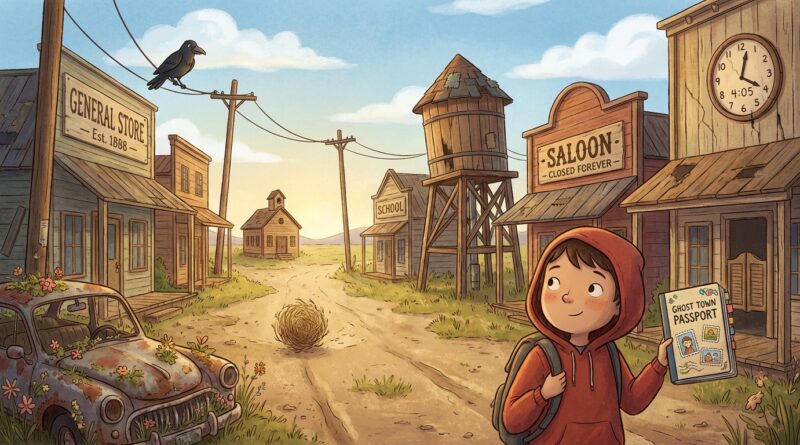
The Kid Who Collected Ghost Towns: Real Places That Vanished Off the Map
Parents get tired of serving up the same kid history facts on repeat. Kids get tired of hearing them. After a while, every family trip starts to sound like another lecture about famous presidents, old battles, or “important landmarks” nobody under 12 really asked about. What usually works better is something stranger. A town that boomed, emptied out, and then slipped so far from daily life it almost feels made up. That is where ghost towns come in. Not the spooky-movie version, but the real kind. Mining camps, railroad stops, island villages, and drought-hit communities that once buzzed with life and now sit quiet, half-gone, or hidden in plain sight. If your child likes mysteries, maps, ruins, or asking “what happened here?”, these kid friendly ghost town history facts can turn an ordinary weekend drive into a true adventure, without making history feel dry or creepy.
⚡ In a Hurry? Key Takeaways
- Real ghost towns are one of the easiest ways to make history click for kids because they turn big events like gold rushes, droughts, fires, and changing roads into stories tied to actual places.
- Start with family-safe sites that offer signs, museums, walking paths, or ranger programs, then let your child play detective by spotting clues about why the town faded.
- Stick to legal, public areas only. Many abandoned places are unsafe or on private land, but well-managed ghost towns can be fun, low-cost, and surprisingly educational.
Why vanished towns grab kids so fast
Children love one big question. “How can a whole town just disappear?”
That question opens the door to history without the usual groan. A ghost town is not just a pile of old wood. It is a story with clues. Empty shops. Broken sidewalks. A schoolhouse with no students. A train line that no longer matters. Kids can see the evidence, not just hear about it.
This is why kid friendly ghost town history facts work so well. They give children something to picture. Instead of memorizing dates, they start thinking like explorers. Who lived here? What jobs did they do? Why did families leave? What stayed behind?
That shift matters. It turns history from “stuff that happened before” into a real-life puzzle.
The kid who “collected” ghost towns
Picture a curious kid with a notebook in the back seat, peering out the window every time the family passes an old cemetery, a boarded-up general store, or a faded sign for a town nobody seems to live in anymore. One stop becomes two. Two becomes a habit. Soon the child is “collecting” ghost towns the way other kids collect baseball cards or weird rocks.
That idea sounds playful, but it is also how many young history fans get started. They are not chasing haunted stories. They are chasing clues.
One town might have dried up after the railroad moved. Another may have emptied when a mine stopped producing silver. Another was flooded for a dam project, burned in a wildfire, or simply bypassed when the highway went somewhere else. Each place tells kids something concrete about how people build communities, and how fragile those communities can be.
The fun part is that these stories often feel close enough to touch. They are not trapped inside a textbook. They are sitting off a county road, tucked behind a state park sign, or hiding near a vacation spot your family already visits.
Kid friendly ghost town history facts that are actually worth sharing
1. Some ghost towns were once busy, noisy, crowded places
Kids often imagine ghost towns as tiny, sad little settlements. In reality, some were booming. They had hotels, bakeries, saloons, schools, newspapers, blacksmith shops, and packed main streets.
That surprise lands well with children. It helps them see that “abandoned” does not mean “unimportant.” It often means the opposite. The town mattered a lot, until something changed.
2. A town did not always die because of one dramatic disaster
Sometimes families left after a flood or fire. But often the end was slower. A mine ran low. A railroad route shifted. Jobs disappeared. Young people moved away. Stores closed. Then more people left.
This is useful for kids because it shows how places depend on work, travel, water, and community. One missing piece can start a chain reaction.
3. “Vanished off the map” does not always mean physically gone
Some ghost towns still have buildings. Others exist only as foundations, cemetery plots, road names, or marks on old maps. A few were swallowed by forests, lakes, sand, or later development.
That makes a nice lesson in maps too. Kids can compare an old map with a modern one and spot names that disappeared.
4. Many ghost towns were built around one idea
Gold. Silver. Coal. Timber. Railroads. Farming. Fishing. One main resource often supported the whole town.
That is a simple, kid-friendly way to explain rise and fall. If the resource dried up, the town often did too.
5. Not every ghost town is in the Wild West
That is a fun myth to bust. Yes, the American West has famous examples. But vanished towns can be found all over. New England mill villages, Midwestern railroad stops, Southern mining camps, island communities, and even neighborhoods cleared for highways all count as places that faded away.
For families, this is good news. You may not need a big road trip. Your own state may have a lost town story nearby.
Real places kids can learn from
Bodie, California
Bodie is one of the best-known ghost towns in the United States, and for good reason. It was a gold-mining boomtown that once had thousands of residents. Today it is preserved in a state of “arrested decay,” which means it is kept from falling apart completely, but not rebuilt to look shiny and new.
For kids, that makes it feel real. They can look through windows and see dishes, furniture, and shelves left in place. It feels less like a museum exhibit and more like time paused.
Best lesson for children: boomtowns could grow very fast, and shrink just as fast when the money ran out.
Calico, California
Calico started as a silver mining town. It is more rebuilt and tourist-friendly than some ghost towns, which makes it easier for younger kids. That also means families can get the atmosphere without as much rough terrain.
Best lesson for children: mining shaped entire communities, and when the metal was no longer worth enough, people moved on.
Cahawba, Alabama
Cahawba is a great reminder that ghost towns are not all dusty desert scenes. It was once Alabama’s first state capital. Flooding, political changes, and economic shifts helped lead to its decline.
Kids can learn that even important places can fade. Power does not guarantee permanence.
Kennecott, Alaska
This former copper mining town is dramatic, remote, and tied to a huge industrial story. The giant mill buildings alone can spark a child’s imagination.
Best lesson for children: remote towns can thrive when a resource is valuable, then empty when business changes.
Centralia, Pennsylvania
Centralia is famous because an underground mine fire has burned for decades. It is a fascinating story, but it is also one to handle carefully with kids because some coverage leans dark.
The family-safe takeaway is simple. Human choices, industry, and geology can shape towns in ways nobody expected.
How to make ghost town history fun instead of grim
A lot of social media coverage gets this wrong. It either pushes cheap scares or gives you five seconds of drone footage and no real story. Kids deserve better than both.
Try this instead.
Give your child a mission
Ask them to find three clues about why the town existed. Maybe it is near tracks. Maybe there is mining equipment. Maybe the buildings are clustered near water.
Then ask the follow-up question
What changed?
This keeps the visit active. Kids are not just looking. They are thinking.
Bring a simple “history detective” kit
A notebook, pencils, printed old photos if you can find them, and a paper map can go a long way. A child who sketches an old jail or writes down a funny store name will remember more than a child who just hears facts.
Use nearby sites to build a bigger adventure
If your child likes hidden history in general, pair a ghost town stop with places that reveal what sits under or behind modern life. A good next step is Real-Life Invisible Cities: Secret Tunnels, Hidden Rooms And Underground Worlds Kids Can Actually Visit. It fits nicely because both kinds of trips teach kids the same big idea. Places have layers, and the best stories are often the ones most people drive past.
How families can “collect” ghost towns safely
This part matters more than the spooky stuff ever will.
Stick to legal public sites
Many abandoned places are on private land. Others are fragile, fenced off, or truly dangerous. A family-friendly ghost town visit should be boring in one specific way. It should follow the rules.
Look for managed locations
State parks, national park areas, local history sites, and preserved mining towns are your best bet. They often have signs, trails, restrooms, and context that helps kids understand what they are seeing.
Do not enter unstable buildings
Even if a structure looks solid in photos, old floors, nails, glass, and collapse risks are real. Tell kids the goal is to observe, not to “urban explore.”
Watch the weather
Many ghost towns are in hot, dry, isolated places. Water, hats, snacks, and sturdy shoes matter. So does a bathroom stop before you get there.
Keep the tone curious, not creepy
You do not need to sell the trip as scary. For most kids, the true story is already interesting enough. A vanished post office and a school with no students is plenty mysterious on its own.
Easy questions to ask kids on the spot
If you want the trip to turn into a real conversation, these prompts help:
- Why do you think people built a town here and not somewhere else?
- What jobs do you think children and adults had here?
- What clue tells you this place used to be busy?
- What would have made families decide to leave?
- What do you think this place looked and sounded like on its busiest day?
Those questions work in the car too, which is half the point. Ghost towns are great because they stretch the trip beyond the stop itself.
How to find local ghost town stories without planning a giant vacation
You do not need a famous destination to use this idea.
Start with local historical societies, state park websites, library archives, and old county maps. Search for vanished mill towns, former railroad communities, lost mining camps, drowned towns, or old settlements near reservoirs. Even if the town itself is mostly gone, a marker, museum room, old cemetery, or photo archive can still give your child that “I found something forgotten” feeling.
This is often where the best stories live anyway. Not in polished tourist spots, but in half-remembered local history.
Why this works better than another random fact book
Because it gives history a shape.
A child may forget a list of dates by next Tuesday. But they are less likely to forget standing on a quiet street where a hundred families once lived, worked, argued, shopped, and hoped for something better.
Ghost towns also connect naturally to other subjects. Geography. Weather. Economics. Engineering. Transportation. Even environmental science. A vanished town is rarely just one story. It is a mix of many.
At a Glance: Comparison
| Feature/Aspect | Details | Verdict |
|---|---|---|
| Educational value | Teaches kids how jobs, weather, transport, and natural resources can make towns grow or disappear. | Excellent for hands-on history |
| Family friendliness | Best at preserved public sites with signs, trails, and basic facilities, not remote trespassing spots from social media. | Choose managed locations |
| Cost and effort | Can be a low-cost add-on to a drive, park visit, or vacation, especially if you focus on nearby local history. | High value for little money |
Conclusion
Ghost towns hit a sweet spot many parents are looking for. They are weird enough to hook kids, true enough to teach something real, and flexible enough to fit into a normal family day. Better yet, they offer a clean break from passive scrolling. Instead of watching strangers wander abandoned places online, your child gets to notice clues, ask questions, and build a story from the ground up. That is a much better trade. The best kid friendly ghost town history facts do not just fill time on a road trip. They give families a new way to look at the world around them. An empty lot, an old rail bed, a strange town name on a faded map. Any of them could be the start of the next treasure hunt. And once kids catch on, they often never stop looking.