The Secret History Of Your Sofa: Everyday Objects That Started Out Totally Different
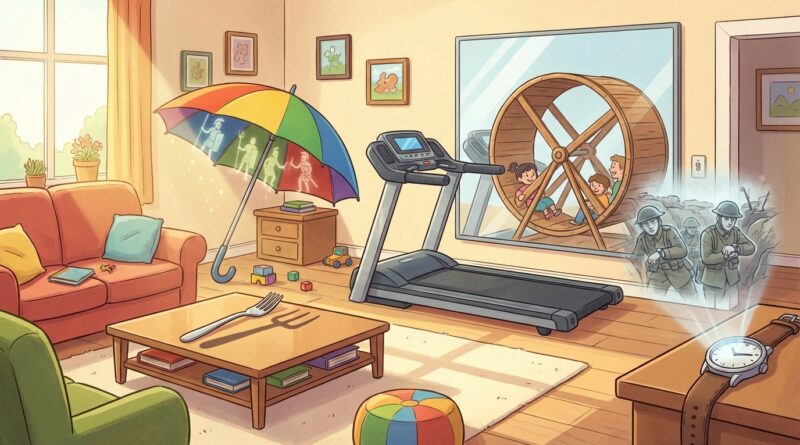
If you have ever tried to make history fun for kids, you know the problem. The minute a story starts sounding like a list of dates, eyes glaze over and somebody reaches for a tablet. That is why the weird history of everyday household objects for kids works so well. You do not need a museum trip or a costume. You just need to point at the stuff already sitting around your house and say, “Want to hear something strange?” Suddenly the fork at dinner is not just a fork. The umbrella by the door is not just for rain. Even the treadmill at the gym has a backstory that sounds more like a villain’s invention than a fitness machine. These stories are odd, memorable, and easy to repeat. Best of all, they turn ordinary family moments into mini history lessons that feel more like shared jokes than schoolwork.
⚡ In a Hurry? Key Takeaways
- Many everyday objects started out with totally different jobs, including status symbols, military tools, or even punishments.
- Use one strange object story at dinner or in the car to spark easy, screen-free family conversation.
- Keep it kid-safe by focusing on the surprising change over time, not the scary details.
Why kids love the secret history of ordinary stuff
Kids are natural detectives. They love finding out that the world was not always arranged the way it is now. A spoon seems normal. A fork seems boring. An umbrella is just an umbrella. Then you tell them a fork was once seen as shocking table behavior, and suddenly they are paying attention.
This kind of history works because it starts with something familiar. Kids can hold it, point to it, and imagine how people used it long ago. That makes the story stick.
Parents like it too, because you do not need to prepare a lesson. You can pull out one fact while clearing plates, folding laundry, or walking through a store. It is low effort and high payoff.
The fork. Once fancy, strange, and a little scandalous
Why people were suspicious of it
Today, handing a child a fork is about as ordinary as handing them a napkin. But when forks first began showing up at tables in parts of Europe, some people thought they were unnecessary, fussy, or even rude. For a long time, many people simply ate with knives, spoons, and their fingers.
Early table forks were often linked with wealthy people. That meant they could seem snobbish, like showing off with a gadget nobody really needed. In some places, people even thought using a fork for food was unnatural because your hands already did the job.
Why it changed
As cooking styles changed and manners became more formal, the fork started to make sense. Messy foods became easier to manage. Over time, the “strange” utensil became standard.
That is a great kid lesson right there. Something can seem weird at first and still become normal later. A lot of inventions follow that path.
Dinner table question to ask
Try this. “What do you think people in the future will use every day that seems weird to us now?” That question can lead to funny answers and some solid critical thinking.
The umbrella. Not just for rain
It started as shade, status, and protection
Umbrellas have a much older story than most people think. In ancient cultures, umbrella-like tools were often used to block the sun, not the rain. They could signal power and wealth too. If someone had a shaded canopy over them, it often meant they were important.
That alone is enough to get a kid’s attention. The thing tossed in your hallway basket once had royal energy.
Battlefield connections
Some large shield-like coverings and portable canopies in the ancient world also helped protect people during travel and military movement. They were not the neat folding umbrellas we know now, but the basic idea was similar. A portable cover could protect from heat, weather, and flying debris in rough conditions.
So when you say umbrellas helped on ancient battlefields, the kid-safe version is simple. Long ago, protective coverings were useful in war as well as in daily life. The object changed shape and purpose over time until it became the rainy-day tool we know.
What makes this story useful
It helps kids see that objects evolve. People keep the helpful part of an idea, then redesign the rest. That is basically the history of technology in one sentence.
The treadmill. From punishment to workout
This one has the biggest plot twist
The treadmill may be the king of strange object history. Long before it became gym equipment, an early version called the treadwheel was used for hard labor. In the 1800s, treadmills were even used in prisons. People would walk step after step on a rotating device for hours. It was exhausting and meant to be punishment.
Yes, the machine many adults now pay to use has a family tree that includes forced labor. That is a wild sentence, and kids usually think so too.
How it became exercise gear
Over time, the basic idea of repetitive walking machinery was reshaped for health and fitness. Doctors and trainers began to use treadmills for testing and exercise. Then home fitness culture took over, and the treadmill became a symbol of working out.
That makes it one of the clearest examples of an object switching identities completely. Same basic motion. Totally different purpose.
Kid-safe way to tell it
You do not need to lean into harsh details. Just say, “Long ago, treadmills were not for exercise. They were machines for exhausting work. Later, people changed the idea and used it for fitness instead.” That keeps the story true without making it too heavy.
Other everyday objects with surprisingly odd beginnings
Napkins
Napkins feel ordinary now, but shared cloths and special table linens once signaled wealth and formal dining. In other words, your paper napkin has roots in fancy table culture.
Chairs
For much of history, not everyone had one. In many places, chairs were linked with authority. Important people got the seat. Others got stools, benches, or the floor.
Mirrors
Modern mirrors are cheap and common. Earlier versions were expensive and often made from polished metal. Seeing your own reflection clearly was once more of a luxury than a daily habit.
These are great bonus stories if your kids want a round two after the fork and treadmill.
How to use these stories without making it feel like school
Play “guess the original job”
Pick an object in the room and ask, “What do you think this was first used for?” Let everyone guess before you reveal the answer. Wrong guesses are half the fun.
Keep each story under one minute
You do not need a speech. One weird fact is enough. The goal is curiosity, not a lecture.
Use chores as your stage
Loading the dishwasher. Sorting umbrellas by the door. Walking past gym equipment. Those are perfect times to drop a tiny history bomb.
Focus on change over time
The big lesson is not just that objects are weird. It is that people adapt things. They solve one problem, then another, then another. That is history, design, and problem-solving all rolled together.
Why this matters more than it seems
These stories do more than fill silence in the car. They teach kids to ask better questions. Who made this? Why did they make it? What problem was it solving back then, and what problem does it solve now?
That is real critical thinking. It is also a sneaky way to build interest in history without making kids feel trapped in a lesson.
And for adults, it is a nice reminder that “boring” objects are usually not boring at all. They are just old enough to seem normal.
At a Glance: Comparison
| Feature/Aspect | Details | Verdict |
|---|---|---|
| Fork | Started as a luxury table tool and was once seen as odd or overly fancy. | Best for quick dinner-table conversation. |
| Umbrella | Early versions were used for sun protection, status, and practical cover in rough conditions, including military settings. | Great for showing how one idea changes shape over time. |
| Treadmill | Originally tied to hard labor and punishment before becoming exercise equipment. | Most dramatic story, and usually the one kids remember best. |
Conclusion
The next time screen-free time starts to feel like a battle, skip the flashcards and look around the room instead. The fork was once scandalous. Umbrellas have roots that stretch far beyond rainy sidewalks. Early treadmills were closer to human hamster wheels than workout machines. That is more than trivia. It gives families easy, strange little stories to swap at dinner, in the car, or while doing chores. And while everyone is laughing or saying, “Wait, really?” kids are quietly building a love of history and learning how to think about change, design, and human problem-solving. That is a pretty good use for a boring old household object.