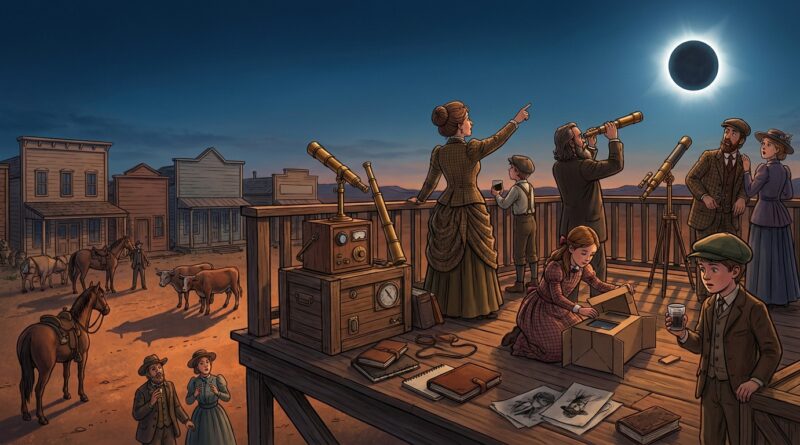
The Solar Eclipse Race: The Day Scientists Chased the Shadow Across America
You can feel the problem, right away. Your child spots eclipse glasses at the checkout line, gets excited for five minutes, then asks, “So what’s the big deal?” And suddenly you are trying to turn a sky event into a real story, not just a science fact. The good news is that total eclipses already come with one. In the 1800s, scientists did not just step outside and look up. They hauled cameras, telescopes, clocks, chemicals, notebooks, and fragile glass plates onto trains and wagons. Then they raced across America to stand in the Moon’s shadow for just a few minutes. It sounds a little like a treasure hunt, a little like a sports event, and a little like a magic show. That is what makes solar eclipse history facts for kids so useful. They turn “the sky got dark” into a human adventure full of planning, risk, wrong guesses, and big discoveries.
⚡ In a Hurry? Key Takeaways
- Total eclipses pushed 19th century scientists to travel fast, carry delicate gear, and work under intense time pressure.
- Turn eclipse night into a family activity by retelling the “race to the shadow” story, then have kids pack their own pretend observation kit.
- Always use proper eclipse glasses for partial phases. Looking at the Sun without safe eye protection can damage eyesight.
Why eclipse history hooks kids so fast
Kids do not always care about dates. They do care about a race.
That is why this story works. A total solar eclipse is not visible everywhere. Scientists had to figure out where the Moon’s shadow would fall, then get there on time. If clouds rolled in, or a train was late, or a camera jammed, the chance was gone.
Gone for years. Sometimes decades.
That pressure made eclipse expeditions feel huge. They were part science project, part road trip, part gamble. For families looking for solar eclipse history facts for kids, this is the sweet spot. It is real history, but it has momentum.
The basic science, in kid-friendly terms
A total solar eclipse happens when the Moon moves between Earth and the Sun and blocks the Sun completely for a short time. The dark center of the Moon’s shadow is called the path of totality.
If you are inside that path, day can briefly look like twilight. Stars may appear. The air can feel cooler. Animals sometimes act confused.
If you are outside that path, even a little, you only get a partial eclipse.
That detail mattered enormously to scientists. “Close enough” was not close enough.
The day scientists chased the shadow across America
During the 19th century, eclipse expeditions became major events. Teams spread out across likely viewing spots so at least some observers might get clear skies. In the United States, that often meant heading into places that were harder to reach than they look on a modern map.
Think trunks, wooden crates, handwritten instructions, and equipment that did not like dust, bumps, heat, or hurry.
Now add one more problem. The eclipse itself might last only a few minutes.
So after days or weeks of travel, all the important work had to happen in a rush. Instruments had to be lined up. Timers had to be checked. Sketches had to be made quickly. Photos had to be attempted with early cameras that were far less forgiving than a phone camera today.
What they were trying to learn
They were not traveling just for fun, though fun probably helped. Eclipses gave scientists a rare chance to study parts of the Sun usually hidden by its bright surface.
During totality, they could examine the corona, which is the glowing outer atmosphere of the Sun. They also studied strange bright features near the edge of the Sun called prominences.
These observations helped answer big questions. Were these glowing features part of the Sun? Part of Earth’s atmosphere? Optical tricks? Eclipses helped sort that out.
Why timing was everything
Totality is brief. Miss the moment, and the Sun comes blazing back.
That made eclipse teams obsessive about clocks and schedules. One mistake could ruin the whole trip. In some cases, bad weather ruined it anyway. That is an important part of the story too. Science is not a straight line. It is often careful work mixed with disappointment.
Maria Mitchell and the human side of eclipse science
If you want one name to share with kids, Maria Mitchell is a great place to start. She was a pioneering American astronomer and teacher, famous for discovering a comet in 1847. She also took part in eclipse observing and encouraged women to take science seriously at a time when many doors were still shut.
She makes the story bigger than gadgets. She reminds kids that science is done by people, not by machines alone.
You can tell children that Maria Mitchell was not just “watching the sky.” She was part of a generation trying to understand it with patience, skill, and courage. That lands well, especially for kids who like role models more than raw facts.
Yes, Thomas Edison belongs in the eclipse story too
Thomas Edison is often remembered for the light bulb, but he also appears in eclipse history. During the 1878 total solar eclipse, he promoted an instrument called the tasimeter. It was designed to detect tiny changes in heat, and he hoped it could help study the Sun’s corona.
That detail is wonderful for kids because it shows that famous inventors did not stay in one lane. They chased interesting problems.
It also shows something else. Not every much-hyped idea turns out to change the world. Some tools impress people in the moment, then fade. That is not failure in a gloomy sense. It is how science often works. People try things. Some stick. Some do not.
Why the American frontier made the story feel even wilder
Today, if an eclipse is coming, you can check maps on your phone, book a hotel, and read weather forecasts all week. In the 1800s, travel took more effort and more luck.
Scientists and their assistants crossed long distances by rail, wagon, and ship. Equipment had to survive the trip. Food, lodging, and local conditions all mattered. Some groups set up in temporary camps. Others borrowed buildings or open land.
This frontier feel is part of what makes the tale so vivid for families. It was not a calm stroll into history. It was a scramble.
Three solar eclipse history facts for kids that are actually memorable
1. Scientists had only minutes to do their work
That is the headline fact. Imagine studying for weeks, traveling for days, and getting four minutes to perform.
2. Early eclipse photography was hard
Photographs were not instant. Equipment was bulky, exposures were tricky, and setting up took real skill. A single mistake could waste the chance.
3. Bad weather could beat the smartest team
Even brilliant scientists could lose to clouds. This is one of the best lessons for children. Nature does not always cooperate, and that is part of honest science.
How to tell this story at home without making it feel like homework
You do not need a lecture. You need a scene.
Try something like this at dinner or bedtime:
“Pretend it is 1878. You have packed glass lenses, notebooks, and a brand-new instrument. You have crossed half the country. If clouds cover the Sun at the wrong moment, you lose your one shot. What do you pack? Where do you stand? Who keeps the time?”
That turns a history lesson into a family game.
An easy 15-minute activity plan
Step 1: Draw a simple map of the United States and sketch a thick line for the eclipse path.
Step 2: Give each child a piece of paper and say, “Pack your eclipse expedition trunk.” They can list five items.
Step 3: Read out problems. “Your camera broke.” “Clouds are coming.” “The train is late.” Let them solve each one.
Step 4: End by stepping outside safely during an eclipse event, if one is happening, with certified eclipse glasses.
Now they have a story, not just a worksheet.
What this history quietly teaches kids
The nicest part of this topic is that it slips in bigger lessons without sounding preachy.
Curiosity matters. Preparation matters. Teamwork matters. So does disappointment.
Kids often see science as a pile of right answers in a textbook. Eclipse history shows a different picture. It shows people racing, guessing, improving tools, making mistakes, and trying again.
That is much closer to real life.
A quick safety note parents should not skip
This part is simple but important. You must use proper eclipse viewers or certified eclipse glasses when any part of the bright Sun is visible. Regular sunglasses are not safe.
The only time it is safe to look directly without eclipse glasses is during the brief total phase of a total solar eclipse, and only if you are truly inside the path of totality and the Sun is fully covered. If you are unsure, keep the glasses on.
For most family viewing, the safest rule is also the easiest one. Use proper eclipse glasses the whole time unless you are very certain totality has begun.
At a Glance: Comparison
| Feature/Aspect | Details | Verdict |
|---|---|---|
| 19th century eclipse expeditions | Slow travel, bulky equipment, uncertain weather, very short viewing window | A perfect real-history adventure for kids |
| Science lesson value | Shows how discoveries come from planning, teamwork, and repeated attempts | Excellent for teaching how science really works |
| Family activity potential | Easy to turn into map work, role play, packing games, and safe skywatching | High. Fun, memorable, and low-stress |
Conclusion
A total solar eclipse is already exciting, but the history behind it makes it stick. Instead of “the sky went dark for a bit,” kids get a true adventure story. Scientists hurried across America, lugged fragile gear, argued over ideas, tried new inventions, and sometimes lost everything to a patch of clouds. That is a much richer picture of science. It gives families a ready-made evening activity, introduces real people like Maria Mitchell and Thomas Edison, and shows children that curiosity is not neat or perfect. It is brave, messy, competitive, hopeful work. And that may be the best reason to share solar eclipse history facts for kids in the first place. The eclipse becomes more than a cool thing to see. It becomes a story they can carry with them long after the shadow has passed.