Weird History of Everyday Toys: Surprising Origins of the Games Kids Love
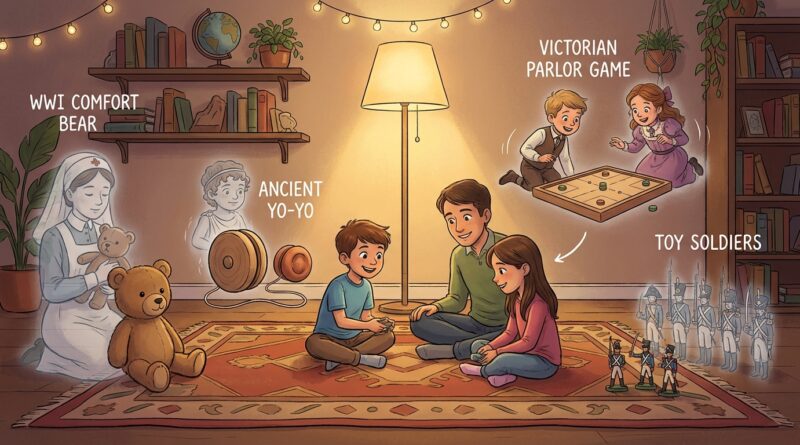
If you have ever stepped on a toy at the end of a long day and thought, “Please let this thing be useful for once,” you are in good company. Parents are always looking for screen-free fun that does not feel like homework in disguise. The good news is that some of the most ordinary toys in your house already come with strange, wonderful backstories. The weird history of toys for kids is full of surprises. A yo-yo may have started as a hunting tool. Teddy bears owe their name to a president and a bear hunt that made headlines. Even board games have roots in royal courts, gambling tables, and military thinking. That means playtime can become history time without anyone groaning. You do not need a museum trip, a craft bin, or extra prep. You just need a few toys from the floor, a little curiosity, and maybe a child willing to say, “No way,” every thirty seconds.
⚡ In a Hurry? Key Takeaways
- Many everyday toys have odd origins, including ancient tools, royal pastimes, and games linked to war training.
- Pick three toys at home and ask, “Was this first used for fun, for work, or for practice?” to turn cleanup into a history scavenger hunt.
- Keep the stories age-appropriate. The fun is in the surprise, not in making old history sound scary.
Why toy history is so much more fun than a trivia list
Kids usually love facts when the facts feel a little weird. Not textbook weird. Good weird. The sort of fact that makes them stop spinning a top and ask why anybody thousands of years ago thought, “Yes, this should also help train the next generation.”
That is what makes the weird history of toys for kids such a useful parent trick. You are not handing out random trivia. You are connecting a toy in your house to a real piece of human history. Suddenly a plush bear is not just a plush bear. It is a news story, a political moment, and a toy industry turning on a dime.
Yo-yos were not always just for tricks
The simple toy with a surprisingly old past
The yo-yo feels modern because it shows up in schoolyards, magic kits, and birthday party bags. But versions of it go back a very long way. Historians have found evidence of yo-yo-like toys in ancient Greece. In the Philippines, stories have also linked similar objects to hunting and combat, though some of those tales are debated and often repeated more confidently than historians would like.
That is actually part of the fun here. Toy history is messy. Some stories are rock solid. Some are half legend, half family folklore that got printed enough times to sound official.
What to tell kids
You can keep this one simple. Say, “People have been playing with yo-yo-style toys for thousands of years, and some old stories say they may even have been used for hunting or training.” Kids do not need a lecture on source quality. They just need the sense that this little spinning thing has lived a lot of lives.
Then ask them to try a trick and imagine doing it without YouTube tutorials, in sandals, two thousand years ago.
Teddy bears came from a very public bear story
Why they are called teddy bears
This one is wonderfully specific. In 1902, President Theodore Roosevelt went on a hunting trip. During the trip, guides cornered and tied up a black bear for him to shoot. Roosevelt refused. A political cartoon about the event spread quickly, and toy makers saw an opening. Soon stuffed bears were being sold as “Teddy’s bears.”
That means the teddy bear was not named because “teddy” sounded cute. It was tied to a real person, a real news event, and a burst of media attention. If that happened now, it would be a viral plush launch by Tuesday.
Why kids love this one
Children love finding out that a bedtime toy has a newspaper origin story. It feels impossible and true at the same time. It also gives you an easy side lesson about how quickly trends can spread, even before the internet.
Board games often started as serious business
Ancient games were not always just for passing time
Board games have been around for thousands of years. Senet was played in ancient Egypt. The Royal Game of Ur goes back to ancient Mesopotamia. Chess developed from earlier strategy games linked to warfare and planning. Even when a game looked like fun, it often carried bigger ideas with it, including luck, status, religion, or military thinking.
So when your child dumps checker pieces on the carpet, you can cheerfully point out that humans have been gathering around little squares and arguing over moves for ages.
What makes this useful for parents
Board games are one of the easiest ways to mix history into ordinary family time. You do not need to stop the game and turn into a museum guide. One sentence is enough. “Games like this used to help people practice strategy.” That single line changes the mood. The game feels older, bigger, and somehow cooler.
Tops may be one of humanity’s oldest toys
Spinning tops have appeared across many cultures for centuries. Some were made from clay, wood, or bone. They are so simple that people likely invented them again and again in different places. A top is a good reminder that a toy does not need batteries, speakers, or a “smart” label to survive thousands of years.
If you want a quick family challenge, ask your kids why tops have lasted so long. The answers are usually better than anything adults come up with. “Because they are tiny and dramatic” is honestly pretty strong.
Kites were not just for nice breezy afternoons
Kites have a long history in Asia, especially in China, where they were used for far more than play. Over time, they were used for signaling, measuring distance, testing wind, and in some cases military communication. That means one of the prettiest outdoor toys in the shed may have cousins that once helped with serious planning.
This is a great one to bring up on a windy day because it turns the usual “go outside for a bit” into a mini adventure. Flying a kite can suddenly feel like testing a very old idea.
Dolls started as more than playthings
Dolls are ancient too. Archaeologists have found dolls in many old civilizations, and they were not always used just for children’s play. Some had religious or ceremonial meaning. Some reflected fashion, social status, or family roles. Over time, dolls also became a way for children to act out the world around them.
That makes dolls an interesting bridge between toy and storytelling tool. A child is not just playing. They are rehearsing life, trying out roles, and building little worlds with whatever toy is nearby.
How to turn toy history into a living room scavenger hunt
Start with three toys
You do not need a big setup. Grab three toys that are already in sight. A stuffed animal, a game, a spinning toy, a doll, a kite, blocks, whatever is around.
Ask three questions
For each toy, ask:
1. Is this toy old or new?
2. Do you think it started as fun, work, or practice?
3. Who do you think used it first, kids, adults, soldiers, or royalty?
Then reveal the answer, or at least the most likely answer. The guessing is half the entertainment.
Keep it playful, not perfect
You do not need to fact-check every sentence like you are writing a museum plaque. Just stick to broad, reliable points and be honest when a story is partly legend. Kids actually respond well to that. “People are not fully sure, but here is the story” feels like a mystery, not a weakness.
Three great toy stories to use tonight
1. The yo-yo story
“This toy is ancient. People have played with versions of it for thousands of years, and some stories say it may have been used for hunting or training.”
2. The teddy bear story
“This bear is named after a president called Theodore, nicknamed Teddy, after he refused to shoot a trapped bear on a hunting trip.”
3. The board game story
“Games like this have been around for ages, and some early board games helped people think about luck, planning, and strategy.”
That is it. You now have a five-minute history session that does not feel like a lesson.
What this teaches kids without them noticing
There is a sneaky amount of learning here. Kids start to notice that ordinary objects have histories. They begin to understand that inventions change over time. They see that fun and function often mix together. A toy can be silly now and serious then. Or the other way around.
That is a useful way to think about technology too. The things we use every day, from phones to kitchen tools, usually have odd beginnings. Toys are just the friendliest place to start that idea.
At a Glance: Comparison
| Feature/Aspect | Details | Verdict |
|---|---|---|
| Best surprise factor | Teddy bears and yo-yos have the strongest “Wait, really?” origin stories for younger kids. | Great for instant attention |
| Easiest toy to use for a history chat | Board games work well because they naturally lead into strategy, ancient games, and family discussion. | Best for mixed ages |
| Lowest-effort parent activity | Grab any three toys, ask whether they began as fun, work, or practice, then share one short fact about each. | Simple and repeatable |
Conclusion
The best part of the weird history of toys for kids is that it asks almost nothing from tired parents. No crafts. No printing. No special trip. You can read this, look down at the living room floor, and turn three ordinary toys into a historical scavenger hunt before the kettle boils. That gives kids fun stories to tell friends and teachers, and it helps sneak real history into everyday play without making it feel forced. Which is exactly the sort of thing The Brilliant Professor Ponzey would approve of. The world is full of interesting facts. Sometimes they are hiding under the sofa cushions, next to a yo-yo and a slightly scruffy teddy bear.