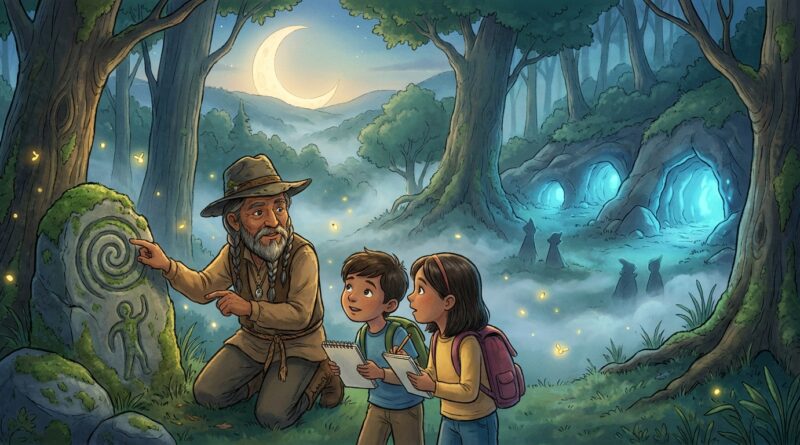
History’s Glow-in-the-Dark Mystery Tribes: The True Legend Of The Moon‑Eyed People Of Appalachia
Picking spooky stories for kids is harder than it should be. One minute you want something fun and mysterious. The next minute you are stuck between made-up monsters, scary internet nonsense, or history books so dry everybody checks out by page two. The moon eyed people legend for kids sits right in that tricky middle. It is a real Appalachian legend tied to Cherokee storytelling and old local history, but it has also been stretched online into wild claims that go way beyond the evidence. The good news is that the original tale is interesting enough without adding aliens, secret lost races, or nightmare fuel. If your family has seen clips about a pale people who “could not bear the light,” this is the calm, useful version. We will sort out what the legend says, what historians can actually support, and how to share it with kids in a way that stays curious, respectful, and not too creepy.
⚡ In a Hurry? Key Takeaways
- The Moon-Eyed People are part of an Appalachian legend, not a proven lost tribe confirmed by archaeology.
- For kids, present it as a mystery story from Cherokee-connected tradition, then ask, “What is the story, and what is the evidence?”
- Keep it respectful. Avoid turning Indigenous stories into conspiracy bait or treating real cultures like fantasy creatures.
What is the Moon-Eyed People legend?
The basic version goes like this. Long before European settlers arrived, a strange group of people lived in parts of the southern Appalachians. They were said to be pale, small, or different-looking, and most famously, they “could not bear the light of day.” Because of that, they were supposedly active at night or in dim conditions.
In some retellings, the Cherokee defeated or drove them away. In others, the story gets attached to old stone ruins in places like western North Carolina or northern Georgia. One of the towns most often pulled into the legend is Fort Mountain, where a long stone wall has inspired local guessing for generations.
That is the part kids usually latch onto. A hidden people. Moonlight. Mountains. Ruins. It sounds like a campfire story because, honestly, it kind of is.
Where did the story come from?
This is where it helps to slow down. The Moon-Eyed People story is often linked to Cherokee oral tradition and to 19th-century writers who recorded regional stories secondhand. That matters, because once legends get written down by outsiders, details can shift. A storyteller might simplify things. A local historian might add a dramatic flourish. A newspaper writer might turn a maybe into a definitely.
One often-cited source is Benjamin Smith Barton, an early American writer who mentioned a tradition about “moon-eyed people” in the Appalachians. Later authors repeated the story, and over time it grew legs online.
So yes, this is an old legend. But no, that does not mean every modern version is equally trustworthy.
Myth versus evidence, in plain English
What counts as legend?
The legend says there was a mysterious group who struggled in sunlight. It may preserve a memory of conflict, a misunderstood neighboring group, or a symbolic tale that changed over time. Legends do that. They carry meaning, even when they do not work like a court document.
What counts as evidence?
Evidence would be things like archaeological finds, written records close to the event, or strong agreement among reliable historical sources. Right now, there is no solid proof of a separate “Moon-Eyed People” tribe exactly as internet videos often describe them.
Archaeologists have not confirmed a hidden pale underground civilization in Appalachia. Historians have not uncovered a neat file labeled “mystery night people solved.” What we have is a regional legend, some old references, a lot of retellings, and many guesses.
Why the confusion keeps happening
Because people love a mystery, and the internet rewards the most dramatic version. “Interesting old legend with uncertain origins” gets fewer clicks than “scientists baffled by vanished tribe.” But the first one is much closer to the truth.
So who were the Moon-Eyed People supposed to be?
There are several theories. None are proven.
Some people think the story may refer to a real group the Cherokee encountered, remembered later in exaggerated form. Others think it could be a folk explanation for ancient ruins or walls whose builders were not fully understood by later communities. A few writers have tried to connect the legend to Europeans, Albinos, Welsh explorers, or other lost-population ideas.
This is where adults need to put on the brakes.
Many of those theories are more imaginative than factual. Some old “lost race” ideas also come with baggage. They were sometimes used to downplay or erase Indigenous history by implying Native peoples could not have built impressive structures themselves. That is not a small issue. It is one reason respectful storytelling matters here.
How to explain the moon eyed people legend for kids
You do not need a lecture. You just need a simple script.
Try this: “This is a real old legend from the Appalachian region. People passed it down because it was mysterious and memorable. Some parts may come from real history, but historians do not have enough proof to say exactly who the Moon-Eyed People were.”
That gives kids three useful ideas at once.
- Old stories can be meaningful.
- Not every story is a proven fact.
- Asking questions is part of the fun.
For younger kids, keep the focus on mystery, mountains, and moonlight. For older kids, add the big lesson: “A cool story is not the same thing as evidence.” That is a skill they can use far beyond folklore.
Is it too scary for children?
Usually, no. Not if you keep it grounded.
The original legend is eerie, but it does not have to be nightmare material. Skip the creepier internet art, the fake “documentaries,” and anything that turns the story into horror. Stick with the idea of a regional mystery. Think old ruins and unanswered questions, not jump scares.
If your child is sensitive, frame it as a history puzzle instead of a ghost story. “People in this area told a tale about a group who only liked the dark. Nobody knows exactly what inspired the story.” That is spooky enough for fun, but not overwhelming.
Places families may hear about in the legend
Fort Mountain, Georgia
This is one of the most famous places tied to the story. The ancient stone wall at Fort Mountain State Park has sparked lots of theories. Visitors can hike, see the wall, and talk about how people try to explain old structures when they do not have all the facts.
Western North Carolina and southern Appalachia
The broader legend lives across parts of the Appalachian region, especially in areas connected with Cherokee history. If you visit, it is worth looking for museums, cultural centers, and state parks that share Native history with care and context.
The best family trips are the ones where the legend is only the starting point. The real payoff is learning about the land and the people who have lived there for generations.
How parents can keep this respectful
This part matters most.
Indigenous stories are not just spooky content for social media. They come from real communities. So when talking about the Moon-Eyed People, avoid jokes about “primitive myths,” and avoid presenting Cherokee-connected traditions as if they are silly fairy tales that modern people have outgrown.
At the same time, respect does not mean pretending every dramatic claim is true. It means being honest. Say what the legend is. Say what is unknown. Say when online storytellers are stretching things.
A good rule is this: treat the people connected to the story as real people, not props in a mystery video.
A simple family activity: Legend or evidence?
Here is an easy way to turn this into a smart conversation.
Make two columns on paper.
- Legend: Moon-Eyed People could not stand sunlight.
- Evidence: Old writers recorded versions of this story.
- Legend: They built every strange stone structure in Appalachia.
- Evidence: No solid proof supports that claim.
- Legend: They were definitely a lost European tribe.
- Evidence: That is a theory, not a confirmed fact.
Kids usually enjoy this more than adults expect. It feels like detective work. And quietly, it teaches media literacy.
Why this legend is trending again
It checks every internet box. It is short. It is weird. It sounds half historical and half supernatural. And it comes with scenic mountain footage, which always helps.
But trending is not the same as trustworthy. Short clips often leave out the Cherokee connection, skip the uncertainty, and jump straight to “mystery solved” nonsense. That is why this is a good moment for families to pause and add context before sharing.
What to say if your kid asks, “Is it real?”
Use the honest middle answer.
“The legend is real. People really told this story. But the exact Moon-Eyed People described in the legend have not been proven by historians.”
That sentence does a lot of work. It respects the tradition, avoids fake certainty, and keeps curiosity alive.
At a Glance: Comparison
| Feature/Aspect | Details | Verdict |
|---|---|---|
| Legend origin | An old Appalachian story often linked to Cherokee tradition and later retellings | Real legend, but details vary |
| Historical proof | No strong archaeological or documentary proof of a separate “Moon-Eyed” tribe exactly as described online | Unproven |
| Best use for families | A gentle mystery that opens discussion about oral tradition, evidence, and Appalachian history | Great with context |
Conclusion
The Moon-Eyed People story is exactly the kind of legend families stumble across online and want to share right away. And honestly, I get it. It is eerie, memorable, and tied to real places you can actually visit. The smart move is not to avoid it. It is to handle it well. A Cherokee-rooted mystery tribe said to “could not bear the light” is bubbling up again in history and science feeds, and plenty of clips are flying around without much context. This is your chance to slow it down a little. Enjoy the weirdness. Keep the wonder. But label myth versus evidence clearly, and use the moment to teach kids something bigger than one spooky story. You are not just passing along a legend. You are showing them how to be curious without getting pulled into bad history, and how to respect Indigenous storytelling while learning about Appalachia in a thoughtful, grounded way.