History’s Trickster Eyes: True Stories Of Optical Illusions That Fooled The Whole World
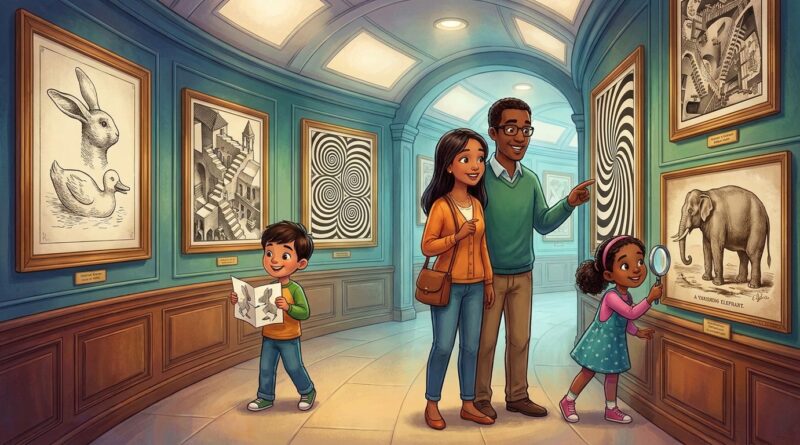
Kids spot an optical illusion and instantly say, “Whoa.” Then comes the hard part. Why does it look wrong when nothing is actually wrong? That is where many parents and teachers get stuck. You want the wonder, but you also want the real explanation. Not a dry science lecture. Not another ten second internet trick that vanishes as fast as it arrived. The good news is that history is packed with optical illusions that confused artists, scientists, crowds, and even entire cities. These stories are weird, funny, and perfect for kids because they show that our eyes are amazing, but not always reliable. Better yet, they connect beautifully to the tilted rooms, mirror mazes, and forced perspective photo spots showing up in optical illusion museums today. Once kids hear the story behind the trick, they stop being passive viewers and start becoming little detectives. That is when the real fun begins.
⚡ In a Hurry? Key Takeaways
- Historical optical illusions for kids work best when you pair the strange story with a simple explanation of how the brain guesses size, depth, color, or motion.
- At a museum or at home, ask one question first. “What is your brain assuming here?” That turns a cool photo into a science lesson kids actually enjoy.
- Most illusion activities are safe and low mess, but dizzy rooms, spinning patterns, and flashing visuals can overwhelm some children, so keep visits short and take breaks.
Why old optical illusions still grab kids today
The best illusions do two jobs at once. They entertain kids, and they quietly teach skepticism. That matters.
When a child sees a wall that looks slanted, a picture that seems to move, or two lines that appear different lengths even though they are equal, they learn a big idea fast. Seeing is not the same as knowing.
That is exactly why historical optical illusions for kids are so useful. They are not just party tricks. They are mini lessons in art, psychology, science, and even history.
And unlike random social media clips, these stories have staying power. A child remembers that a whole room can make one person look giant and another tiny. Then later, when they visit an illusion museum, they recognize the trick and want to test it for themselves.
True stories of optical illusions that fooled the world
1. The leaning towers of art. Forced perspective fooled viewers for centuries
Long before camera phones, artists learned how to bend reality on flat surfaces. Renaissance painters used perspective to make ceilings look impossibly tall, domes look open to the sky, and halls seem longer than they really were.
One famous example is trompe-l’oeil, a French term that means “deceive the eye.” Artists painted columns, windows, and arches so convincingly that people felt they could step right into them.
Why it fooled people: your brain uses shadows, line angles, and size clues to judge distance. If those clues are drawn carefully, a flat wall can feel like deep space.
Kid-friendly takeaway: the eye collects clues. The brain makes a best guess.
Try this at home: use sidewalk chalk to draw a giant hole or a long road on your driveway. Stand at one exact spot and watch the drawing suddenly look real. Move a few steps away and the magic falls apart.
2. The Ames Room made people shrink and grow like magic
This one feels like a wizard built it, but it came from science. The Ames Room, created in the 1940s by American scientist Adelbert Ames Jr., is a specially shaped room that looks normal from one viewing hole. In reality, it is wildly uneven. One corner is much farther away and the floor and ceiling tilt.
When two people stand in opposite corners, one appears giant and the other tiny.
Why it fooled people: your brain assumes rooms are rectangular. That assumption is so strong that it overrides the weird truth.
This is one of the clearest links between old illusions and modern museum attractions. Many “giant and tiny” photo rooms are direct descendants of the Ames Room.
Ask kids: “If your brain expects a normal room, what mistake does it make?”
Simple experiment: tape a rectangle on the floor and have kids photograph a friend standing near the camera and another farther back. Even without a real Ames Room, they can fake a giant-versus-tiny scene using distance and camera angle.
3. The Moon Illusion fooled almost everybody, including smart adults
You have probably seen this yourself. The moon near the horizon looks huge. Later, when it rises high in the sky, it looks smaller. But here is the twist. Its size on your retina is nearly the same.
People have noticed this for thousands of years. Ancient thinkers wrote about it. Scientists still debate parts of why it feels so strong.
Why it fooled people: when the moon is near trees, buildings, and hills, your brain compares it with objects on Earth and reads it as farther away. A farther object that looks the same size should be huge, so the brain inflates the feeling of bigness.
Kid-friendly test: make a tiny circle with your fingers at arm’s length and compare it to the moon on the horizon and later overhead. The moon fits the same space much more closely than kids expect.
This is a great reminder that an illusion does not mean your eyes are broken. It means your brain is using shortcuts.
4. The Müller-Lyer illusion made equal lines look unequal
This is the classic one with two equal lines. One has arrow tips pointing outward. The other has arrow tips pointing inward. Most people swear one line is longer.
It became famous in the late 1800s and has been used ever since to study how humans judge space.
Why it fooled people: the extra angles act like depth clues. Your brain reads the lines as if they sit in different kinds of 3D spaces, even though they are flat on paper.
Try this at home: draw both versions, ask kids to guess, then measure with a ruler. The ruler becomes the hero of the story.
This is a nice teaching moment because it shows children that tools matter. Sometimes a measurement beats a feeling.
5. The “moving” patterns that do not move at all
Some black-and-white patterns seem to ripple, spin, or crawl when you stare at them. Versions of these effects have fascinated people for well over a century, and artists in the Op Art movement made them famous in the 1960s.
Bridget Riley’s work, for example, left viewers feeling that paintings were vibrating even though the canvas stayed still.
Why it fooled people: tiny eye movements, contrast, and repeating patterns can confuse the way your visual system tracks edges and brightness.
Kid warning: these are exciting, but some children find them uncomfortable. If anyone feels dizzy, stop and look away.
Museum connection: those swirl tunnels and “moving wall” exhibits use the same basic idea. They push your visual system until your brain starts making incorrect motion guesses.
What these illusions teach kids, besides “that looks cool”
There are a few big lessons hiding inside all of this.
Your brain is a prediction machine
The brain does not passively record the world like a camera. It builds a fast model based on experience. Usually that helps. Sometimes it backfires.
Context changes what we think we see
A line next to arrows looks different. A moon near trees looks bigger. A person in a tilted room looks tiny or huge. The surrounding clues matter.
Science and art are teammates
Artists often discovered illusion tricks before scientists had full explanations. That makes illusions a lovely bridge between museum art rooms and classroom science.
How to turn an illusion museum trip into a real learning moment
It is easy to treat these places like selfie factories. A better plan is to give kids a small mission.
Use the “guess, test, explain” method
Guess: What do you think is happening?
Test: Move to the side. Measure. Take a photo from another angle. Cover part of the image.
Explain: Which clue fooled your brain? Size, depth, shadow, color, or motion?
That three-step routine keeps the sense of mystery while adding critical thinking.
Give kids a short challenge list
Try these prompts during your visit:
- Find one illusion that depends on standing in exactly the right spot.
- Find one that stops working when you close one eye.
- Find one that uses mirrors instead of perspective.
- Find one where a camera sees the trick better than your eyes do.
Now the visit has a purpose, and kids start comparing how different illusions work.
Three plug-and-play optical illusion experiments for home or school
The disappearing thumb trick
Hold your hands in front of you and line your index fingers up with a small gap between them. Focus on something far away behind your fingers. A floating “sausage” shape appears in the middle.
What is happening: your eyes are blending two slightly different views into one strange image.
The checker shadow test
Print or display a checker-shadow illusion online where two squares look like different shades but are actually the same gray.
What is happening: your brain corrects for shadow and lighting, sometimes too aggressively.
The forced perspective photo
Put one child close to the camera and another far away. Have the closer child “pinch” or “hold” the farther person.
What is happening: the camera flattens distance, and your brain reads the two people as if they are closer together than they are.
How to explain illusions to kids without making it boring
Skip the heavy definitions at first. Start with the story.
Say, “People really believed this room was normal.” Or, “For thousands of years, people argued about why the moon looks bigger near the horizon.” A true story gives the illusion stakes. Then the explanation has somewhere to land.
Good phrases to use:
- “Your brain is making a smart guess.”
- “That clue usually helps, but here it causes a mistake.”
- “Let’s see how we can prove it.”
That last line matters most. Kids love being the one who cracks the trick.
At a Glance: Comparison
| Feature/Aspect | Details | Verdict |
|---|---|---|
| Best historical illusion for hands-on learning | Ames Room and forced perspective tricks show size and distance errors in a way kids can photograph and recreate. | Best all-around choice for museum visits and home experiments |
| Best illusion for quick classroom proof | Müller-Lyer line illusion is easy to draw, guess, and measure with a ruler in minutes. | Best for showing that measurement can beat first impressions |
| Best illusion for family discussion outdoors | The Moon Illusion turns an evening walk into a real science conversation with no supplies needed. | Best free option, especially for curious kids who ask big questions |
Conclusion
Optical illusions are having a big moment, and that is not a bad thing. The problem is that many museum trips and pop-up experiences stop at the photo. If you add the backstory, the science, and one or two simple experiments, the whole outing changes. Suddenly, a warped room is not just a funny picture. It is a lesson in how the brain builds reality. That is the real value of historical optical illusions for kids. They give families and teachers a way to keep the magic while adding meaning. So go ahead and enjoy the weird walls, giant chairs, spinning patterns, and impossible mirrors. Just ask one extra question after the laugh. “What fooled us?” That is where curiosity starts, and where science, art, and critical thinking quietly meet.