History’s Oddest Vanishing Roads: True Stories Of Highways That Slipped Underwater, Stopped Mid‑Air Or Went Nowhere At All
If your kids are tired of the same old history hits, you are not alone. A lot of families want stories that feel real, strange, and easy to picture. That is why weird historical road oddities for kids work so well. Roads are ordinary until you find out one sank under a lake, another stops in the sky, and another was built for a future that never came. Suddenly history feels less like memorizing dates and more like solving a mystery on a map. Better yet, these places are tied to real towns, real engineering mistakes, and real human plans that went sideways. That makes them perfect for curious kids, road trip chats, and rainy afternoon map hunts. You do not need to be a history buff to enjoy them. You just need one good question. Like this one. Why would anyone build a road that ends in mid-air?
⚡ In a Hurry? Key Takeaways
- Some of history’s oddest roads really did vanish underwater, stop suddenly, or lead almost nowhere because of floods, politics, money problems, or changing plans.
- Use these road stories as a family map game. Pick one place, find it online, then ask, “What changed here?”
- Stick to safe viewing. Many abandoned roads and bridges are not safe to explore in person, so satellite maps, photos, and local history sites are often the best choice.
Why road mysteries hook kids faster than textbook history
Kids usually perk up when history feels physical. A road is perfect for that. They know what a road is. They have ridden on one all their lives. So when you tell them a highway is now sitting underwater, or an overpass ramps up into empty space, their brains light up.
This is also history with built-in questions. Who made it? Why was it abandoned? What went wrong? That is a lot more fun than a pop quiz.
If your family likes this kind of thing, you would probably also enjoy History’s Strangest Road Trips: Real Places Where the World Got Wonderfully Weird. It has the same “wait, that place is real?” energy.
True stories of roads that did something very strange
1. Roads that slipped underwater
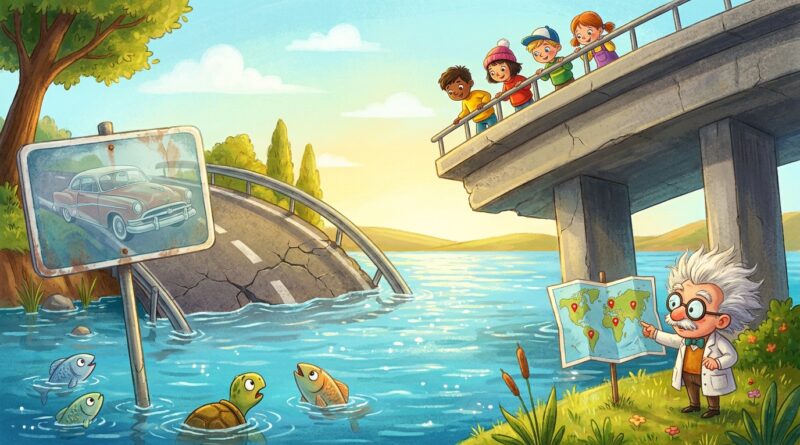
One of the easiest stories for kids to picture is the drowned road. This usually happens when a valley is flooded on purpose to make a reservoir. Towns, farms, bridges, and roads can end up below the waterline. The road did not vanish by magic. It was swallowed by a big human decision.
A famous example is old road networks lost under lakes created by dams. In dry seasons, pieces sometimes reappear. You might see old pavement, bridge stumps, or a road line heading straight into the water. For kids, that is irresistible. It looks like a map glitch, but it is really a frozen piece of the past.
This is also a good moment to explain something simple but important. Infrastructure is not permanent. People build for one era. Then weather, money, and new needs change everything.
2. Highways that stop in mid-air
These are the roads that make everyone laugh first and ask questions second. A ramp rises confidently, then ends. No connecting road. No destination. Just empty space.
These half-finished projects often come from budget cuts, legal fights, public protests, or giant city plans that changed halfway through. In some cities, you can still spot “ghost ramps” and disconnected overpasses built for highways that were never completed.
For kids, the fun part is the image. For parents, the useful lesson is that even huge government projects can change course. A road that looks certain can still become a dead plan in concrete form.
3. Roads to nowhere
This phrase gets used a lot, but some roads really did end up serving almost no purpose. They were built to reach future neighborhoods, factories, resorts, or border crossings that never fully happened. Sometimes the economy changed. Sometimes a war or political shift got in the way. Sometimes planners were simply too optimistic.
The result is a road with an odd feel. It may be far too wide for the area. It may end abruptly in brush or dirt. It may look strangely polished for a place with almost no traffic.
Kids usually get the joke right away. “So they built the road first and forgot the rest?” Not exactly, but close enough to start the conversation.
4. Bridges and roads abandoned when nature won
Not every road mystery comes from bad planning. Some come from geography doing what geography does. Rivers move. Cliffs crumble. Coasts erode. Flood patterns shift.
That is how a useful road can turn into a relic. Maybe a newer bridge replaced it. Maybe storms made the route too risky. Maybe maintaining it cost more than building a new way around.
This is a great kid-friendly lesson in how humans do not fully control the landscape. We work with it, until it stops cooperating.
How to turn these odd roads into a family treasure hunt
You do not need to visit these places to enjoy them. In fact, for many families, the safest and easiest option is a map-based scavenger hunt at home.
Start with one weird clue
Try a prompt like, “Find a road that goes into water,” or “Find an overpass that never connected.” Kids love having a mission.
Use satellite view
Satellite maps are your best friend here. They make the mystery feel concrete. You can zoom in, trace the old route, and ask what changed.
Ask three simple questions
Keep it easy.
What was this road for?
Why did people stop using it?
What does it tell us about that place?
Let kids play detective
Older kids can compare old maps with newer ones. Younger kids can circle the weird part and explain it in their own words. This works especially well during family screen time because everyone can contribute.
Why this feels current right now
Part of the fun is that these stories are not trapped in the past. There is fresh interest in odd local infrastructure, including student-made projects like Ontario Oddities maps that point out abandoned bridges, wrong-way signs, drowned highways, and other strange leftovers.
That matters because it gives families a way into history that feels modern. Kids are not just hearing about ancient monuments. They are seeing how yesterday’s choices are still sitting in today’s landscape.
Safety note parents should not skip
Abandoned roads can look inviting online, but many are not safe in real life. Crumbling pavement, unstable bridges, hidden drop-offs, swift water, and private property rules are real concerns.
So the best family rule is simple. Explore with your eyes first. Use official overlooks, marked trails, museums, visitor centers, and online map tools. If a place looks fenced off or risky, that is your answer.
Easy examples of conversation starters for your next car ride
Here are a few questions that keep the topic fun without turning it into schoolwork.
What would make a whole road disappear?
If you found a bridge to nowhere, what do you think it was supposed to connect to?
Why do cities sometimes stop big projects halfway through?
Do you think future people will find any weird roads from our time?
That last question is especially good. It reminds kids that history is still being made.
At a Glance: Comparison
| Feature/Aspect | Details | Verdict |
|---|---|---|
| Underwater roads | Usually caused by reservoirs, dams, or flooding that covered older routes and sometimes whole communities. | Best for showing kids how landscapes and human choices reshape history. |
| Mid-air highways | Half-built ramps and disconnected overpasses left behind when plans changed or money ran out. | Best for quick “how did that happen?” moments and city planning talks. |
| Roads to nowhere | Built for projects, neighborhoods, or industries that never fully arrived or later failed. | Best for map games and family guesses about what people expected in the future. |
Conclusion
These odd roads do something regular history lessons often do not. They give families a mystery they can actually see. One road sinks under water. Another ends in empty air. Another keeps going long after its purpose is gone. That turns ordinary family screen time into a shared treasure hunt. Kids get bite-size history about how roads can flood, fail, or be forgotten. Parents get easy conversation starters for the next drive. And with fresh interest in projects like the Ontario Oddities map, the topic feels current without being heavy. Best of all, it shows that history is not stuck in dusty books. It is hiding in the infrastructure around us, under our tires, beside our bike paths, and on the maps we scroll every day.