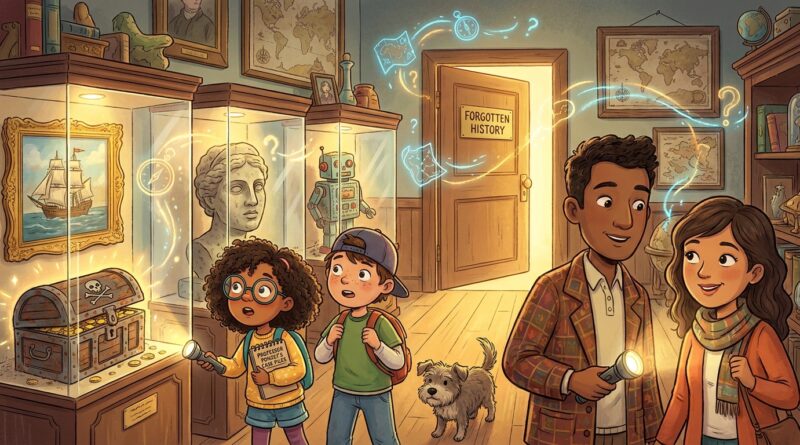
History’s Weirdest Lost‑And‑Found: True Stories Of Things That Vanished For Ages… Then Suddenly Reappeared
If your kids hear one date and immediately look for the nearest snack, you are not alone. A lot of parents want history to feel alive, not like a long line of dusty facts marching across a worksheet. The good news is that history gets much more fun when you skip the timeline and jump straight to the jaw-droppers. A ship buried under city streets. A painting hidden behind a wall. Ancient soldiers sleeping underground for 2,000 years. These are the kinds of true stories that make kids stop scrolling, look up, and say, “Wait. That really happened?” This is where surprising historical oddities for kids really shine. They turn the past into a real-life mystery box. And because these stories are short, visual, and a little strange, they work beautifully for family reading at breakfast, in the car, or in that ten-minute gap before bedtime when nobody wants a lecture but everyone still wants a good story.
⚡ In a Hurry? Key Takeaways
- Some of history’s best family stories are real objects and places that vanished for years, then turned up in surprising ways.
- Use one lost-and-found story at a time, with a picture and one big question, to keep kids interested without turning it into homework.
- These stories are fun, but they also quietly teach patience, curiosity, and how historians piece together clues.
Why “lost and found” history works so well with kids
Kids do not always care when a king was born or which war happened first. Fair enough. Most adults do not either unless the story grabs them.
But say this instead: “A priceless painting was stolen, missing for years, and then found in a kitchen wall.” Now you have an audience.
Lost-and-found history works because it feels like a mystery. There is a thing. It disappears. People guess. Time passes. Then, sometimes by luck and sometimes by stubborn detective work, it comes back.
That structure is easy for kids to follow. It also gives them something school history often skips. Suspense.
True stories of things that vanished, then came back
1. The Terracotta Army slept underground for over 2,000 years
In 1974, farmers in China were digging a well when they hit something unexpected. It turned out they had stumbled onto one of the most astonishing finds in history. Thousands of life-size clay soldiers, along with horses and chariots, buried near the tomb of China’s first emperor, Qin Shi Huang.
Think about that for a second. An entire underground army. Hidden for more than two millennia.
Why kids love it: it sounds made up. Every soldier has different facial features, and the sheer scale feels like a movie set. Except it is real.
What it quietly teaches: amazing discoveries do not always begin with famous explorers. Sometimes they begin with ordinary people doing ordinary things.
2. The Mary Rose came back after more than 400 years underwater
The Mary Rose was a warship built for King Henry VIII. It sank in 1545 during battle, right in view of people on shore. Then it sat on the seabed for centuries.
In the 1980s, archaeologists raised a large section of the ship from the water. Suddenly, people could study not just the ship but the everyday lives of the crew. Shoes, tools, bowls, weapons, even personal items survived in the mud.
Why kids love it: pirate energy, but real. Also, a giant ship being lifted from the sea is hard to beat.
What it quietly teaches: history is not only about rulers. It is also about cooks, carpenters, sailors, and the stuff they carried.
3. The Lascaux cave paintings reappeared because of a dog
In 1940, in France, a teenager and his friends followed their dog into a hole near a hillside. Inside, they found cave walls covered in prehistoric paintings of bulls, horses, and deer.
These images had been hidden for roughly 17,000 years.
That number is almost too big for a child to picture, which is part of the fun. Before cities, before phones, before almost everything they know, people were making bold, beautiful art underground.
Why kids love it: cave art already feels adventurous. Add a dog finding the entrance, and it becomes unforgettable.
What it quietly teaches: ancient people were not “primitive cartoons” from a textbook. They were artists.
4. The Staffordshire Hoard lay buried for 1,300 years
In 2009, a man using a metal detector in England found gold. Then more gold. Then a lot more.
The site turned out to hold the largest collection of Anglo-Saxon gold and silver metalwork ever found in Britain. Sword fittings, crosses, decorative pieces, all buried and forgotten for around 1,300 years.
Why kids love it: treasure. Actual treasure. No fake map required.
What it quietly teaches: archaeology is often part patience, part luck, and part asking, “What on earth is this?”
5. Caravaggio’s paintings turned up in a Dublin house
Sometimes what goes missing is not buried in the earth. Sometimes it is hiding in plain sight.
In the early 1990s, two long-lost paintings by the artist Caravaggio were found in the dining room of a Jesuit house in Dublin. They had been there for years, damaged and darkened, without people fully realizing what they were.
Why kids love it: the idea that a masterpiece could hang around quietly while people walk past it is wonderfully absurd.
What it quietly teaches: not every discovery happens in a desert, jungle, or shipwreck. Sometimes the clue is sitting on a wall.
6. Richard III was found under a parking lot
If you ever wanted proof that history can be weird, here it is. England’s King Richard III died in 1485. For centuries, the exact location of his grave was lost.
Then in 2012, archaeologists digging under a parking lot in Leicester found human remains. After testing, they confirmed them as Richard III.
A king. Under a parking lot.
Why kids love it: because it sounds impossible. It also helps them understand that modern life is built on top of older stories, literally.
What it quietly teaches: cities keep secrets.
7. The Sutton Hoo ship burial hid in the ground until 1939
In Suffolk, England, strange mounds had sat in a field for ages. In 1939, an excavation revealed one of the great archaeological finds of the 20th century. A huge Anglo-Saxon ship burial filled with rich objects, including the now-famous helmet.
The ship itself had mostly decayed, but its outline remained in the soil like a ghost.
Why kids love it: buried ships are instantly exciting. Buried royal ships are even better.
What it quietly teaches: even when an object is gone, traces can still tell the story.
What makes these stories stick
They are short. They are visual. And they have a built-in twist.
That matters because many parents are not looking for a 45-minute lesson after dinner. They want five minutes of “You will not believe this” followed by a real conversation.
Try asking simple questions like:
- How do you think it got lost?
- Who do you think found it first?
- What would surprise you most if it turned up in your town?
You do not need a PhD for this. You just need curiosity.
How to turn this into a fun family habit
Start with one object, not a whole era
“Let’s learn about ancient China” can sound huge and heavy. “Let’s look at the underground clay army farmers found by accident” feels manageable.
Use pictures first
For surprising historical oddities for kids, pictures do a lot of the lifting. A buried ship, a gold hoard, a cave wall full of animals. Show the image, then tell the story in three beats. Lost. Forgotten. Found.
Keep the timeline loose
You can mention dates, but they do not have to lead. Let the human moment lead. The date can come second.
Pair the story with a real outing
If your family likes this style of history, you might also enjoy Family Oddity Quest: The Real Museums Of Weird History Hiding In Plain Sight. It is a handy next step when your kids are more likely to perk up for odd artifacts and strange exhibits than another “educational” day out that feels suspiciously like homework.
One helpful note for parents
Not every “rediscovered” object comes with a neat ending. Some finds raise new questions. Some spark arguments over ownership. Some are partly destroyed before people realize their value.
That is not a flaw. It is actually part of the lesson.
History is not a finished book. It is more like a puzzle with pieces still turning up.
At a Glance: Comparison
| Feature/Aspect | Details | Verdict |
|---|---|---|
| Best for instant wow-factor | Terracotta Army, Richard III under a parking lot, buried treasure finds | Great for grabbing reluctant listeners fast |
| Best for visual learners | Lascaux cave paintings, shipwrecks, gold hoards, rediscovered art | Pictures make the story click in seconds |
| Best learning payoff | Shows how archaeology, chance, and detective work help rebuild the past | Fun first, but surprisingly educational |
Conclusion
When history is served as nothing but dates and rulers, it is easy for kids to tune out. But when it arrives as a missing ship, a buried king, or a cave full of art no one had seen for thousands of years, the whole thing changes. These stories give families quick, picture-friendly wow moments that feel human, strange, and real. Better still, they gently show that the past is not dead and settled. It is full of second chances, patient searchers, and mysteries still waiting for the next lucky finder. That is why these surprising historical oddities for kids work so well. They do not ask children to memorize someone else’s timeline. They invite them to notice that history is still popping back into view, one astonishing rediscovery at a time.