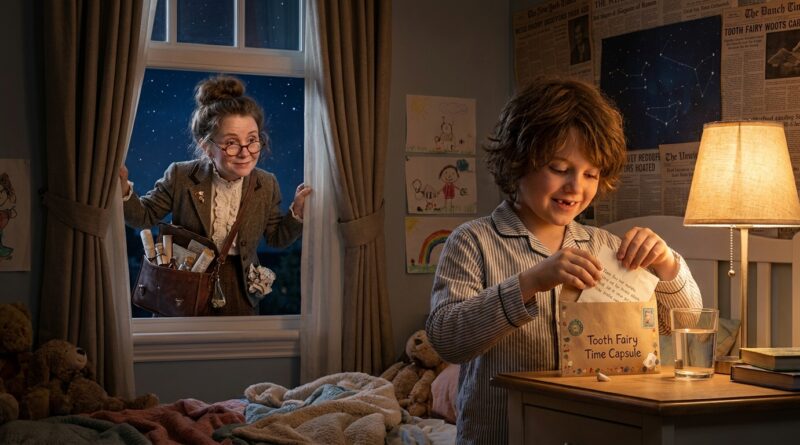
History’s Strangest Tooth Fairy: The 114‑Year‑Old Legend Who Collects Teeth And Starts Family Traditions
You know the moment. Your child is holding a tiny tooth in their hand, looking at you like you are the official keeper of Tooth Fairy facts, and all you have is the same old line about “put it under your pillow.” That gets the job done, but it is not exactly memorable. The good news is the Tooth Fairy is much stranger, older, and more real-on-paper than most parents realize. If you have been looking for a screen-free family tradition that feels easy but still magical, this is a good one to start tonight. The short version is this. The modern Tooth Fairy has a documented paper trail going back 114 years, and families have imagined her in all kinds of ways, from a tiny winged visitor to a mouse-like collector of teeth. That mix of folklore, newspapers, and bedtime magic gives you more than a routine. It gives you a story kids actually want to hear again.
⚡ In a Hurry? Key Takeaways
- The modern Tooth Fairy has a real documented history going back more than a century, with newspaper and print references from 1908 onward.
- You can turn lost teeth into a simple family ritual by adding a note, a tiny tooth envelope, or a “Tooth Fairy record” page.
- This is a low-effort, screen-free tradition that also teaches kids that even everyday myths can leave a trail in books and archives.
So, how old is the Tooth Fairy really?
If you are searching for tooth fairy history for kids, here is the fun part. The Tooth Fairy is not some brand-new cartoon invention. The character most families recognize today has a documented history that reaches back 114 years.
One of the earliest printed references often pointed to is from 1908, in a newspaper piece encouraging parents to help children place lost teeth under a pillow for a fairy reward. That matters because it shows the idea was not just floating around as spoken folklore. It was written down. Once something lands in print, it becomes easier to trace.
That does not mean nobody had tooth traditions before 1908. They absolutely did. Families in different countries tossed teeth into fires, buried them, gave them to animals, or saved them for luck. But the specific figure of the modern Tooth Fairy, a nighttime visitor who swaps a tooth for money or a gift, appears in the record in the early 1900s.
Why the Tooth Fairy feels older than she is
Part of the confusion comes from the fact that tooth-losing traditions are much older than the fairy herself. For centuries, people thought baby teeth needed to be handled carefully. Some believed a child’s future health, luck, or even adult teeth could be affected by what happened to that tiny tooth.
So the fairy is relatively modern. The worry, ritual, and excitement around lost teeth are ancient.
Old traditions were wonderfully weird
In some places, children threw teeth onto the roof. In others, they buried them. Some gave them to mice, who were admired for their strong teeth. That mouse connection still shows up today in parts of Europe and Latin America, where a tooth-collecting mouse appears instead of a fairy.
That is one reason kids love this story when they hear the full version. It is not one neat official tale. It is a mix of customs families kept changing over time.
The 114-year paper trail parents can actually use
This is where the story becomes especially useful at home. You do not have to present the Tooth Fairy as “just believe because I said so.” You can say something better.
You can tell your child that parents and newspapers were already talking about the Tooth Fairy more than a century ago. That puts the tradition in a real-world frame. Kids often enjoy magic more, not less, when they learn it has a history.
If your child likes odd old facts, this can open the door to bigger conversations about how stories get recorded. A newspaper clipping, a magazine mention, a handwritten note in a family scrapbook. That is how legends stick around.
It is the same kind of delight kids get from surprising true history, like Rhinos in the Snow? The True Story of Ice Age Unicorns That Lived in the Arctic. Children often remember history better when it feels a little strange.
What families have imagined the Tooth Fairy to be
Here is another detail parents usually do not hear. There has never been one fixed Tooth Fairy rulebook.
Some families picture her as tiny and sparkling. Some see her as more practical, like a secret nighttime collector. Some leave coins. Some leave notes. Some swap the tooth for a tiny book, sticker, or a “first lost tooth” certificate.
That flexibility is not cheating. It is the tradition.
There is no single “correct” version
If your child asks questions like, “Why does my friend get more money?” or “Does the Tooth Fairy carry all the teeth at once?” you do not need a perfect universal answer.
You can say every family tells the story a little differently, just like families tell holiday stories differently. That answer is honest, and it matches the history.
A simple Tooth Fairy ritual you can start tonight
If you want a low-effort tradition, keep it very small. The easiest rituals are the ones you will actually repeat.
Option 1: The tiny envelope method
Put a small envelope or folded paper under the pillow instead of a loose tooth. That makes the late-night swap easier, and it feels more special.
Option 2: A Tooth Fairy receipt
Leave a tiny note that says something like, “Received: 1 very shiny front tooth.” Kids love this. It takes 20 seconds and turns a coin into an event.
Option 3: A tooth history page
Keep a simple page in a notebook with the date, which tooth fell out, and what the Tooth Fairy left behind. Years later, it becomes a family time capsule.
Option 4: Add one real-history sentence
Tell your child, “Did you know families have been writing about the Tooth Fairy for more than 100 years?” That one line makes the ritual feel connected to something bigger.
How to answer the hard kid questions
Children are excellent cross-examiners. Here are a few gentle ways to handle the big ones.
“Is the Tooth Fairy real?”
You can answer based on your family style. Some parents keep the magic going. Others say the Tooth Fairy is a story families act out together, like a game of make-believe with a long history. Both approaches can work.
“Why does she want teeth?”
Try this. “That is part of the mystery, but people have wondered about children’s teeth for hundreds of years.” It keeps the wonder while nodding to the real history.
“Did people always have a Tooth Fairy?”
You can say, “Not exactly. People had lots of tooth traditions first, and later the Tooth Fairy became popular.” That is simple, accurate, and easy for kids to grasp.
Why this tradition still works so well now
It is small. It is cheap. It asks for almost no setup. And it gives children a sense that ordinary life can still hold a little mystery.
That is a big deal right now. Many parents are tired of traditions that require shopping lists, subscriptions, printables, and one more thing to manage. The Tooth Fairy can still be a scrap of paper, a coin, and a story told in a dark hallway after bedtime.
Better yet, it quietly introduces a smart lesson. Stories do not just live in movies. They show up in newspapers, books, family memories, and little habits passed from one house to the next.
At a Glance: Comparison
| Feature/Aspect | Details | Verdict |
|---|---|---|
| Historical origin | The modern Tooth Fairy has a documented print trail going back to the early 1900s, commonly cited from 1908. | Real enough to trace, magical enough to enjoy. |
| Family tradition value | Works as a quick ritual with a note, envelope, coin, or small keepsake. | Easy win for busy parents. |
| Learning opportunity | Helps kids see how myths, customs, and newspaper records all mix together over time. | Fun and quietly educational. |
Conclusion
The next time a tooth falls out, you do not have to fall back on the same two-sentence bedtime script. You can tell your child that the Tooth Fairy has a strange little history, one that has been written down for more than a century, and that families all over the world have imagined tooth collectors in their own ways. That makes the tradition feel richer without making your night harder. For parents hunting for screen-free, low-effort magic, this is one of the best kinds of family ritual. It is simple, repeatable, and rooted in something real. Best of all, it gives kids a fresh story to hear tonight while quietly showing them that even everyday legends can leave clues in newspapers, archives, and family memory.