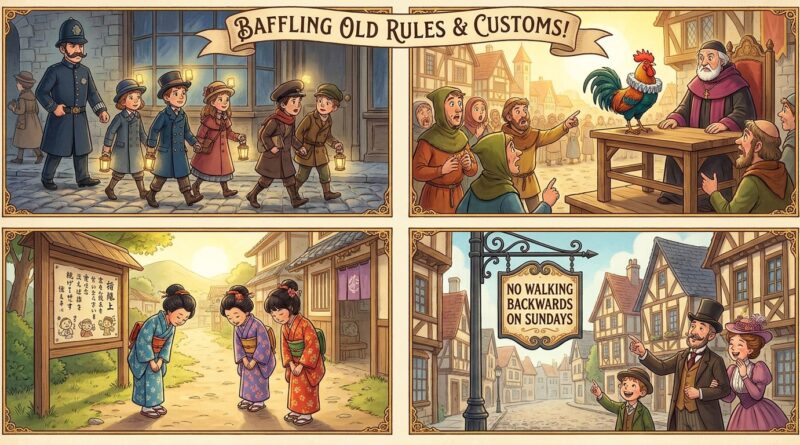
History’s Most Baffling Everyday Rules: Real Laws And Customs That Make Zero Sense Today
If you have a kid who loves weird history, you probably know the problem. You go looking for one fun fact about old laws, and five minutes later the internet is throwing out made-up nonsense, nightmare fuel, or “facts” that fall apart the second you check them. That gets old fast. Parents and teachers should not need a hazmat suit just to find interesting history. The good news is that there really are plenty of weird historical laws and customs for kids that are surprising, true, and safe to talk about at the dinner table. Better yet, these odd rules are not just random trivia. They open the door to bigger questions. Why did people think this rule made sense? Who benefited from it? Why do customs change? A good odd law is like a tiny time machine. It lets kids see that the past was full of real people making choices, some clever, some silly, and some that make no sense at all today.
⚡ In a Hurry? Key Takeaways
- Many truly weird old rules were created for practical reasons at the time, even if they sound ridiculous now.
- Use each strange law or custom as a conversation starter by asking, “What problem was this trying to solve?”
- Age-safe history works best when the facts are surprising but not scary, gross, or exaggerated for clicks.
Why strange old rules are so useful for kids
Kids love a rule that makes adults say, “Wait, what?” That natural curiosity is gold. It makes history feel less like a list of dates and more like a world full of puzzles.
The trick is picking examples that are real enough to trust and gentle enough to share. That is why weird historical laws and customs for kids can be so helpful. They give children something memorable, but they also teach a bigger lesson. Rules are not handed down from the sky. People make them. People argue about them. And later, other people look back and wonder what on earth everyone was thinking.
7 baffling everyday rules and customs that sound wild now
1. Medieval towns sometimes had curfews tied to fire, not bedtime
The word “curfew” comes from an old French phrase connected to covering a fire. In many medieval places, an evening bell told people it was time to bank or cover hearth fires for the night.
That sounds odd if you think of curfew as “kids, get home.” But in a world of wooden houses, open flames, and crowded streets, this was really about not burning down the neighborhood.
Kid-friendly takeaway: A rule that sounds bossy now may have started as a basic safety feature.
2. Sumptuary laws told people what they could wear
In different parts of Europe and Asia, rulers passed “sumptuary laws” that limited certain fabrics, colors, furs, or jewelry to certain classes of people. In simple terms, the government was saying, “You cannot dress like that because you are not high-ranking enough.”
By modern standards, that feels deeply weird. Imagine needing legal permission to wear a fancy purple outfit. But these laws were meant to control status, spending, and social order.
Why it matters: Clothes were not just clothes. They were social signals.
3. In some places, church attendance was treated almost like a civic duty
In early modern Europe and colonial America, some communities expected regular church attendance so strongly that skipping could lead to fines or public trouble. Today that can sound shocking, especially in places where religion is seen as a private choice.
But back then, religion, government, and community life were often tightly mixed together. Showing up was not only about faith. It was also about being seen as a responsible member of society.
Conversation starter: Which of today’s “normal expectations” might look strange 300 years from now?
4. Some cities regulated when you could bake bread
In premodern towns, baking was not always a private kitchen activity. In some places, ovens were shared, fuel was expensive, and local authorities tightly controlled trade and food production. Rules could govern when bread was baked, who could bake it, and how it was sold.
That sounds fussy, but bread was a daily staple. If the supply went wrong, people got angry fast.
Kid-friendly takeaway: The more important something is, the more likely people are to make rules about it.
5. People once followed strict mourning customs for clothing
In the 1800s, especially in Victorian Britain and places influenced by it, mourning had a whole rulebook. People might wear black for set periods, avoid certain social events, or slowly shift into less severe colors as time passed.
To kids today, this can seem baffling. Why would grief have a dress code? But these customs helped people show loss publicly at a time when social signals mattered a lot.
What it shows: Customs often act like a shared language. They tell other people how to behave around you.
6. In some times and places, markets had official rules for fairness that feel oddly specific
Old markets could be full of rules about weights, measures, prices, and the order in which goods were sold. Some of those rules get wonderfully specific. The point was to stop cheating before it started.
Today, we have labels, receipts, and consumer laws. Back then, a town might use a public measuring standard or inspect goods in person.
Big lesson: Even weird rules often come from familiar problems. Nobody likes being ripped off.
7. Household etiquette could be treated almost like law
Not every baffling rule was written into law books. Some were customs so strong they may as well have been. Rules about who sat where, who spoke first, how letters were written, or when visits were acceptable could shape daily life in a big way.
Children often find this one especially funny. No texting first. No casual drop-ins. No blurting out whatever you want.
Useful point: Customs can be just as powerful as laws, because social pressure is powerful.
How to tell the difference between real history and clickbait nonsense
This is where adults earn their coffee. A lot of “shocking history facts” online are half-true, badly simplified, or fully invented.
Here are three quick filters to use:
Ask, “What problem was this solving?”
If a historical law sounds completely random, there may still be a reason behind it. Fire safety. Social class. Food supply. Public order. Trade. If no sensible context shows up at all, the claim may be flimsy.
Check whether it was a law, a custom, or a rumor
People mix these up all the time. A law is an official rule. A custom is a social habit. A rumor is what gets shared online with a dramatic voice and no source.
Be suspicious of the most extreme version
History content often gets stretched for clicks. “People were fined for skipping church” may be true in some contexts. “Everyone everywhere was forced all the time” usually is not.
Why these stories stick better than ordinary trivia
Kids remember surprise. That is just how the brain works. Tell a child that some people once had rules about what color they could wear, and you have their attention. From there, you can talk about class, fairness, power, religion, or safety without making it feel like a lecture.
That is the sweet spot. A short, odd story with a real point.
Easy discussion questions for home or class
If you want to get more out of these examples, try questions like these:
- Why do you think this rule seemed reasonable at the time?
- Who did this rule help?
- Who did it limit or leave out?
- What modern rule might seem weird to people in the future?
- Is there a difference between a useful rule and a controlling one?
Those questions turn trivia into thinking. And that is much more valuable than one more “you won’t believe this” factoid.
At a Glance: Comparison
| Feature/Aspect | Details | Verdict |
|---|---|---|
| Best type of weird fact | A real law or custom with clear context, like fire safety or clothing rules | Great for kids and classroom discussion |
| Biggest red flag | A dramatic claim with no source, no date, and no explanation of why it existed | Treat with caution |
| Most useful lesson | Rules reflect the needs, fears, and values of a society | Turns odd trivia into critical thinking |
Conclusion
The best history facts do not have to be dark, gross, or exaggerated to be interesting. Right now there is a wave of “shocking history facts” content that chases clicks by getting gloomier and less accurate, and that leaves kids either scared or misinformed. A smarter mix of weird historical laws and customs for kids gives families and teachers something better. It keeps the surprise, but adds context. It invites laughter, questions, and real discussion about how societies work, why people make rules, and how ideas change over time. That means one short read can do a lot. It can help a parent model careful thinking. It can give a teacher a fast discussion starter. And it can give curious kids and grandparents alike something rare on the internet, a mind-bending history fact that is actually worth sharing.