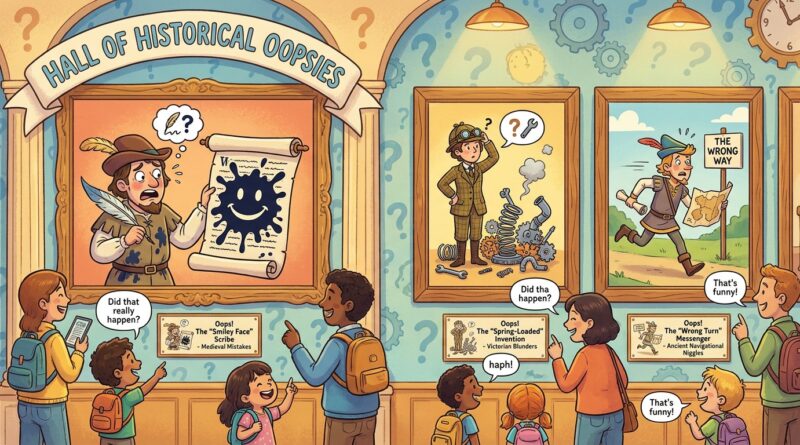
History’s Funniest ‘What Were They Thinking?’ Moments: True Stories That Will Crack Your Whole Family Up
If your kids hear the word “history” and instantly picture dusty wigs, endless wars, and impossible-to-remember dates, that is not your fault. A lot of family history talk gets boiled down to battles, disasters, and names nobody can pronounce. No wonder kids think the past was one long, serious sigh. But real history is full of people doing gloriously odd things, making silly mistakes, and solving problems in ways that make modern families laugh out loud. The good news is you do not need dark facts or made-up internet trivia to make the past fun. You just need a few true, kid-safe stories that show one simple thing. People have always been people. They have slipped, guessed wrong, shown off too much, and occasionally invented chaos by accident. Here are some funny weird history facts for kids that are real, PG-rated, and perfect for dinner tables, car rides, or bedtime.
⚡ In a Hurry? Key Takeaways
- History is packed with funny, true stories, from dancing plagues to exploding desserts and royal fashion disasters.
- Use short “micro-stories” at dinner or in the car to make history feel fun instead of heavy.
- These picks are PG-rated, broadly verified, and chosen to be weird without drifting into nightmare fuel.
Why funny history works so well with kids
Kids do not usually fall in love with history because someone reads them a list of treaties. They connect when the past feels human. A king falling off his horse. A giant dessert collapsing in public. A whole crowd getting carried away by a dance craze. That feels real.
Funny stories also lower the pressure. Nobody has to “study.” You are just telling a quick, true tale that happens to sneak in some learning. That is often enough to open the door.
If your family likes odd places as much as odd stories, The History of World’s Weirdest Museums: Real Places Where The Past Got Really Strange is a fun next stop. It has the same energy. History, but with the boring parts kicked out.
History’s funniest “what were they thinking?” moments
1. The dancing plague that would not quit
In 1518, in Strasbourg, a woman started dancing in the street. That sounds harmless. The weird part is that more and more people joined in, and for days, even weeks, many kept dancing almost nonstop.
People at the time did not know what to do. Some leaders actually thought the cure was more dancing. So they brought in musicians. Which is the kind of plan that sounds bad the second you say it out loud.
Historians still debate exactly what caused it. Stress, illness, mass hysteria, and social pressure all get discussed. But one fact remains. A real town once looked at a dancing emergency and said, “You know what this needs? A band.”
2. The great molasses flood of Boston
Yes, molasses. In 1919, a huge storage tank in Boston burst and sent a wave of sticky syrup through the streets.
It sounds like a cartoon. It was not funny for the people dealing with the damage, of course, but it is one of history’s strangest real events. The tank had been poorly built and poorly tested. Reports say people had even noticed leaks before the disaster. That makes it one of those classic “this seems fine” moments that was very much not fine.
Kids tend to freeze for a second when they hear this one. Then comes the question. “Wait. A flood of pancake syrup?” Close enough.
3. Napoleon and the rabbit disaster
Napoleon Bonaparte expected a proud rabbit hunt. Instead, he got mobbed by rabbits.
According to the famous story, rabbits had been collected for the event, but many were tame or recently trapped and did not behave like wild rabbits. Rather than running away, they charged toward the people, apparently expecting food.
Imagine one of the most powerful men in Europe trying to look impressive while being swarmed by bouncy, hungry fluff. History classes rarely pause long enough to enjoy that image, but they should.
4. A pope put a dead rival on trial
This one sounds made up, but it really happened in the late 9th century. Pope Stephen VI had the body of a former pope, Formosus, dug up and put on trial.
Yes. A trial.
The corpse was dressed in papal clothing and seated for the proceedings. It was part politics, part revenge, and all deeply bizarre. Kids usually react with stunned laughter because the whole thing feels like a prank that somehow became official government business.
It is a strong reminder that adults in history were not always calm masterminds. Sometimes they were dramatic beyond reason.
5. The exploding whale problem
In 1970, officials in Oregon tried to get rid of a dead beached whale with dynamite. Their thinking was simple enough. Blow it up into small pieces and let nature take over.
That was not what happened.
Instead, giant chunks of whale blubber rained down over a wide area. Cars were damaged. Bystanders were shocked. News footage helped turn the whole thing into one of the most famous examples of terrible planning in modern history.
There is a lesson here for kids and adults alike. If your plan sounds like the final scene of a wild cartoon, stop and rethink it.
6. The emperor who loved invisible clothes
This one inspired a fairy tale, but the habit behind it was very real in royal life. Powerful people have often gone along with ridiculous fashion or ceremony because nobody wanted to be the person who said, “This is silly.”
Courts all over Europe were full of massive wigs, towering heels, impossible collars, and outfits that made basic movement harder than it needed to be. Adults were basically playing an expensive game of “pretend this is normal.”
That is part of what makes stories like “The Emperor’s New Clothes” land so well. They feel true because, in many ways, they are. Humans have always been willing to act impressed by nonsense if enough fancy people agree first.
7. The time ketchup was sold as medicine
In the 1830s, a doctor named John Cook Bennett promoted tomato ketchup as a health aid. Before ketchup settled into its modern burger-and-fries life, tomatoes were being pushed in all sorts of health claims.
Then things got even stranger. Some sellers started making tomato pills and pretending they had medical benefits.
This is a great family story because it feels weirdly modern. A questionable health trend. Bold claims. A product people buy because it sounds exciting. The more things change, the more people still fall for shiny nonsense.
8. The leaning tower that started leaning almost right away
The Leaning Tower of Pisa is famous now because of the tilt. But the funny part is that builders had barely gotten started before the ground underneath began causing trouble.
They kept going anyway.
That decision is the historical version of noticing your sandwich sliding off the plate and saying, “Let us stack two more layers on top.” The tower became iconic, but only because a building project went wrong in a very memorable way.
9. A dessert so flaming it became a spectacle
Victorian and Edwardian dining could get wonderfully over-the-top. Fancy meals were not just about eating. They were about showing off. That led to dramatic dishes, giant centerpieces, and desserts served with flames.
Baked Alaska became one of the best-known examples of “food as theater.” It is delicious, but it also feels like someone asked, “What if ice cream wore a warm coat and arrived like a celebrity?”
The funny history angle is that adults have always loved turning dinner into performance art. If your family has ever made a birthday cake too tall for the fridge, you are continuing a proud tradition.
10. The army that lost a battle to buckets, weather, and confusion
Not every military disaster is safe or funny, but some are more about chaos than tragedy. Across history, there have been embarrassments involving wrong turns, lost supplies, bad maps, panicked orders, and plans that collapsed because someone assumed the details would sort themselves out.
One reason kids enjoy these stories is that they make history less mythical. The people in charge were not robots. They forgot things. Misheard things. Broke things. Argued about things. Sometimes the biggest enemy was poor planning.
What makes these stories so satisfying
They all share the same secret. The people involved thought they were being serious.
That is what makes them funny. Nobody wakes up hoping to become the answer to a future child’s favorite weird history question. Yet there they are. Building a leaning tower on soft ground. Bringing in music for a dance crisis. Using dynamite on a whale. Putting ketchup in the medicine lane.
It is not just silliness. It is recognizable silliness. The same kind families still see today when someone ignores instructions, overcomplicates dinner, or insists a bad idea will “probably work.”
How to use funny weird history facts for kids at home
Keep it short
You do not need a lecture. Try one story in under two minutes. Then stop. Let the questions come.
Ask one simple follow-up
Questions help the story stick. Try these:
- What do you think the people should have done instead?
- Which one sounds the most like a cartoon?
- Which one would you least want to clean up?
Let kids retell the story
If a child can retell “the time rabbits chased Napoleon,” they have already remembered more history than they would from a quiz sheet of dates.
Use it as a screen-free family routine
Pick a “weird fact of the night” at dinner, in the car, or before bed. One story is enough. The goal is connection, not homework.
A quick note on accuracy
Weird history gets messy fast online. Some stories get exaggerated because they are shared as memes, not checked as facts. That is why it helps to stick with stories historians have written about, even when details are still debated.
For example, the dancing plague is real, but experts still disagree on the exact cause. That does not ruin the story. It actually gives kids a useful lesson. History is not always one neat answer. Sometimes it is evidence, best guesses, and humans trying to make sense of chaos.
At a Glance: Comparison
| Feature/Aspect | Details | Verdict |
|---|---|---|
| Best kind of history story for families | Short, odd, human-scale mishaps like rabbit hunts gone wrong or ketchup sold as medicine | Easy win for laughs and memory |
| How to share it | Use one micro-story at dinner, bedtime, or in the car, then ask one fun question | Simple, screen-free family connection |
| What to avoid | Random viral “facts” that are too dark, too vague, or not checked | Stick with verified, PG-rated weirdness |
Conclusion
History does not have to feel like punishment. Sometimes the best way in is through the side door, with a dancing mystery, a rabbit ambush, or a very bad whale-removal plan. That is why funny weird history facts for kids work so well. They are quick, surprising, and easy to share without turning family time into school. Better yet, they give parents something rare. A stash of screen-free, accurate, genuinely funny stories that can pop up anywhere, from the back seat to the dinner table. And once kids realize the past was full of regular people making goofy choices, history stops feeling gray and starts feeling alive.