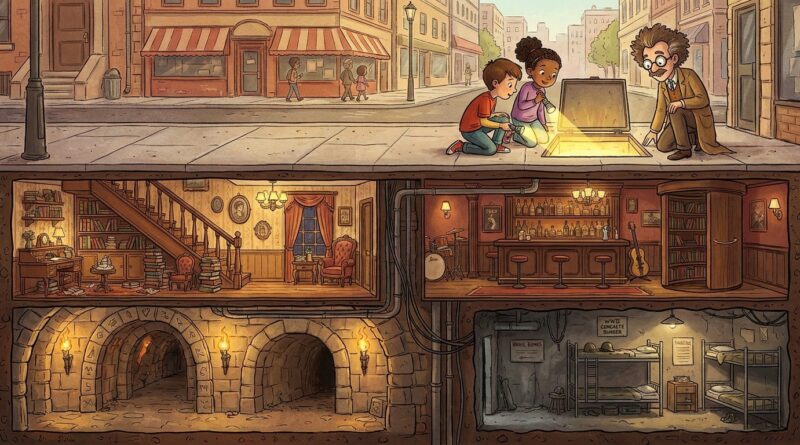
History’s Secret Bunkers: The Real Hidden Rooms, Trap Doors and Underground Lairs Beneath Our Feet
It is oddly hard to find true stories about secret bunkers and hidden rooms in history for kids without bumping into either babyish listicles or dense museum writing that makes everyone’s eyes glaze over. That is the annoying part. The real world is full of trap doors, underground tunnels, wartime bunkers and sealed-up chambers. You just need a guide that keeps the fun part alive. The good news is that history has plenty of “wait, that was under there?” moments. Some were built to hide kings. Some protected families during war. Some were escape routes. Others stayed hidden for hundreds of years until builders, archaeologists or plain bad luck opened them up. If your child loves mystery maps, secret passageways and stories that feel like an adventure movie, these real examples are a great place to start. They also make brilliant bedtime stories, school project ideas and maybe even a future road-trip stop.
⚡ In a Hurry? Key Takeaways
- Yes, real history is packed with secret bunkers, hidden rooms, priest holes, escape tunnels and buried shelters that are every bit as exciting as fiction.
- Start with a few family-friendly examples from castles, wartime cities and ancient tombs, then let kids map them out like mini detectives.
- Stick to museums, guided tours and official historic sites. Never explore sealed tunnels, drains or abandoned bunkers on your own.
Why hidden spaces grab kids so fast
Children love the idea that an ordinary wall, floorboard or hill might be hiding something. Frankly, adults do too. Secret spaces turn history into a puzzle instead of a list of dates.
That matters because “old stuff” can feel distant. A hidden room changes that. Suddenly the past feels close, physical and human. Someone built that door. Someone ducked into that tunnel. Someone hoped they would not be found.
That is why secret bunkers and hidden rooms in history for kids work so well. They bring out suspense, problem-solving and big questions all at once.
Real hidden spaces that sound made up, but are not
1. Priest holes in old English houses
In the late 1500s and early 1600s, some Catholic priests in England were in real danger. Wealthy families who supported them sometimes built tiny hiding spots inside their homes. These were called priest holes.
They were not big secret lairs with glowing buttons. They were cramped, clever and scary. Some were tucked behind fireplaces, inside staircases or under floors. A person might have to stay silent in one for hours, or even days, while searchers looked through the house.
For kids, this is a powerful way to explain that hidden rooms were not always fun. Sometimes they were built because being found could cost someone their life.
2. The secret annex in Amsterdam
One of the most famous hidden rooms in modern history is the Secret Annex where Anne Frank, her family and others hid during World War II. It was concealed behind a movable bookcase in a building in Amsterdam.
This story is heavy, of course, and parents will want to judge what fits their child’s age. But it is also one of the clearest examples of how an ordinary office building could hide an entire world behind one doorway.
The hidden annex was not fantasy. It was a desperate answer to terrible danger. That makes it one of the most important hidden-room stories in history.
3. Churchill’s underground war rooms
During the Second World War, Britain ran part of its war effort from a protected underground headquarters in London. Today many people call it Churchill’s War Rooms.
This was not a rough cave with a lantern. It was a proper underground bunker with meeting rooms, maps, offices and sleeping areas. People worked there while bombs fell above them.
Kids often enjoy this example because it feels part spy base, part command center. It also shows that bunkers were practical. They were built to keep vital people and decisions safe during air raids.
4. The tunnels beneath castles
Not every castle had a dramatic escape tunnel, but many old forts and castles did have hidden passages, postern gates or underground storage spaces. Some were used to move soldiers quietly. Some stored food. Some helped important people escape during a siege.
The trouble is that legends often grow larger than the truth. One local tale becomes “a tunnel all the way to the next town.” Sometimes that turns out to be nonsense. Sometimes archaeologists find a shorter, real passage and the legend turns out to have a grain of truth.
That is part of the fun. Kids get to learn that history is not only about finding answers. It is also about checking stories carefully.
5. Hidden chambers in ancient tombs
Ancient Egypt is full of buried surprises. Tomb builders used sealed chambers, blocked corridors and hidden burial rooms to protect valuables and human remains from thieves.
Even now, researchers still use scans and new tools to search for spaces behind walls or under the ground. That means the story is not finished. Children love hearing that archaeologists are still hunting for hidden rooms in places people have studied for generations.
This is a great reminder that “ancient” does not mean “fully known.”
6. Cold War bunkers
Jump forward to the 20th century and you find a whole different breed of underground space. Cold War bunkers were built in case of nuclear attack. Governments, military planners and sometimes ordinary families prepared shelters stocked with supplies.
These spaces can feel strangely familiar to kids because they look like the kind of secure base they have seen in films and games. The difference is simple and sobering. These bunkers were built because leaders feared a real disaster.
That makes them useful for school projects. They connect history, science, geography and politics in one very visual topic.
Why people built hidden rooms in the first place
Most secret spaces were made for one of four reasons.
Safety
Bunkers, shelters and bolt-holes helped people survive war, raids or persecution.
Escape
Tunnels, hidden stairs and back exits gave people a way out when the front door was no longer safe.
Protection of valuables
Some hidden rooms guarded treasure, documents, weapons or food supplies.
Control and surprise
Military forts often used secret routes so defenders could move unseen or launch a surprise response.
That simple framework helps kids sort each example. Ask, “Was this space built to hide, escape, protect or surprise?” It turns a cool story into a thinking exercise.
How to make this topic fun for kids without making it feel like homework
Turn each place into a mini mystery
Instead of starting with dates, start with a question. “If you had to hide a person in this building, where would you put them?” Then show what people really did.
Draw a map
Kids love overhead views. Sketch a house, castle or bunker. Mark the hidden entrance, escape path and safe room. Suddenly the story clicks.
Use a “what would you pack?” game
If a family had to hide in one room for days, what would they need? Water, blankets, books, food, candles. This helps children think about real life inside the space, not just the dramatic entrance.
Compare fiction to fact
A secret room in a story often looks huge and comfortable. Real hidden spaces were usually dark, cramped and stressful. That contrast is worth talking about.
Best kinds of places to visit if your child is now obsessed
You do not need to find a lost tunnel in your backyard. In fact, please do not try. The safe version of this hobby is much better.
Historic houses
Some old houses and manor homes offer tours that include hidden stairs, concealed cupboards or priest holes.
Castle tours
Many castles have underground chambers, storage rooms and defensive passages open to visitors.
War museums and preserved bunkers
These are often excellent for families because the routes are safe, the signs are clear and the stories are grounded in real artifacts.
Local history museums
Even if your town does not have a giant bunker, it may have smugglers’ tunnels, cellar networks, old air-raid shelters or buried building remains.
This is where local curiosity starts to grow. Kids begin to look at ordinary streets and wonder what used to be underneath them.
A quick reality check on “secret tunnel” stories
Not every legend is true. Towns love to tell stories about tunnels linking churches to pubs, castles to monasteries or mansions to rivers. Sometimes those tales are based on old drains, cellars or wishful thinking.
That does not ruin the fun. It actually improves it. It teaches children a healthy habit. Ask for evidence. Was a tunnel mapped? Excavated? Mentioned in records? Sealed and preserved?
That is how you keep the wonder while also teaching good history skills.
Recent archaeology makes this topic even better
One reason this subject feels so fresh right now is that archaeologists keep finding new underground spaces. Ground-penetrating radar, laser scans and careful digs can reveal buried rooms without smashing through every wall.
So when a child asks, “Are there still hidden chambers nobody knows about?” the honest answer is yes, probably. That is not movie magic. That is active research.
And that is a lovely thought. The earth under old cities, castles and homes still holds secrets.
Safety first, because hidden does not mean harmless
This part matters. Real tunnels and bunkers can collapse. Old air can be dangerous. Flooding, rust, sharp metal and unstable floors are all serious risks.
So the family rule should be simple. Enjoy official tours. Read the stories. Visit museums. Do not climb into abandoned structures, sealed basements, storm drains or random holes in the ground.
You can still get all the mystery without taking any foolish risks.
At a Glance: Comparison
| Feature/Aspect | Details | Verdict |
|---|---|---|
| Most exciting true examples | Priest holes, the Secret Annex, wartime bunkers, castle passages and hidden tomb chambers. | Plenty of real stories that feel like adventure fiction. |
| Best use for families | Bedtime stories, school projects, museum visits, road-trip stops and map-drawing activities. | High value, easy to turn into hands-on learning. |
| Big caution | Many underground places are unsafe, and many local tunnel tales are exaggerated or false. | Stick to verified history and official access only. |
Conclusion
Secret bunkers and hidden rooms in history for kids hit a sweet spot. They feel dramatic and cinematic, but they are also true. That makes them perfect for families looking for fresh stories that can compete with screens without sounding like a lecture. Better still, archaeology keeps adding new underground surprises, so the topic stays alive. A few good examples can give you instant bedtime material, a solid school-project angle and a smart excuse to visit a museum or historic site. Most of all, these stories help children look at the world differently. The street, hill, church, old house or town square nearby might not be boring at all. It might just have another layer under it, waiting to be noticed.