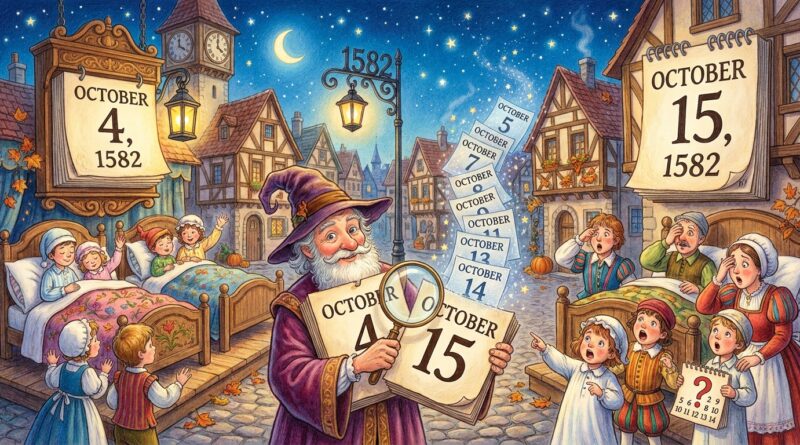
History’s Strangest Missing Day: The Night Everyone Went To Sleep On October 4… And Woke Up On October 15
If your kid has ever shouted, “Wait, how can October 10 just not exist?” you are not alone. Calendar history sounds like one of those topics that should be simple, then somehow turns into a headache. Most explainers either drown you in astronomy or make it sound like people time-traveled. The truth is much weirder, and much more fun to tell at the dinner table. In 1582, in some parts of Europe, people really did go to sleep after October 4 and wake up to a calendar that said October 15. Ten dates were gone. Not because the Earth skipped a spin. Not because time broke. Humans simply edited the calendar to fix a mistake that had been piling up for centuries. That is what makes this such a great kid friendly weird history fact about the missing days in the calendar. It feels like magic, but it is really a story about math, religion, and ordinary people being told, “Sorry, those days are canceled.”
⚡ In a Hurry? Key Takeaways
- The “missing days” happened because countries switched from the old Julian calendar to the more accurate Gregorian calendar.
- If you are telling this to kids, use the easiest version: the seasons were drifting off, so leaders deleted ten dates to catch the calendar back up.
- No one lost ten real sunrises or aged faster. Only the date labels changed, which makes this a safe, fun history puzzle rather than a scary one.
The strange part is real
Here is the short version you can tell in one breath.
In 1582, places like Spain, Portugal, Italy, and Poland used Thursday, October 4, and the very next day on paper became Friday, October 15.
October 5 through October 14 were skipped.
Yes, really.
That sounds fake because we are used to calendars feeling permanent, like mountains or gravity. But calendars are human tools. They are more like rules in a board game than laws of nature.
Why did anyone do something so odd?
Because the old calendar had a tiny bug.
The older Julian calendar treated the year as 365.25 days long. That is close, but not quite right. The actual solar year is a little shorter, about 365.2422 days.
That tiny mismatch does not sound like much. It is only around 11 minutes each year. But little errors can stack up. Think of a clock that loses a few minutes every week. At first, no big deal. After a long time, it is way off.
By the 1500s, the calendar had drifted by about ten days compared with the seasons and important church dates tied to spring.
The easy family version
If you are explaining this to kids, skip the decimal places at first.
Just say this: the calendar was drifting away from the real seasons, so leaders hit the reset button and chopped out ten dates to line things back up.
That is the whole trick.
Who made the switch?
Pope Gregory XIII introduced the new calendar, which is why it is called the Gregorian calendar.
He did not invent time. He approved a fix for the old system.
The repair had two parts.
Part 1. Remove ten dates
This was the dramatic part everyone remembers. Delete ten days on paper. Catch the calendar up.
Part 2. Change the leap year rules
This was the smart part that stopped the problem from growing so fast again.
Under the Gregorian system, most years divisible by 4 are leap years. But century years, like 1700, 1800, and 1900, are not leap years unless they are also divisible by 400.
So 2000 was a leap year. 1900 was not.
It sounds fussy, but it works much better.
Did the whole world skip days at once?
No, and this is where the story gets even weirder.
Different countries switched at different times.
Catholic countries tended to switch first in 1582. Other places waited years, decades, or even centuries because politics and religion got involved. Some Protestant countries did not want to adopt a pope-backed calendar right away. Some Orthodox countries waited even longer.
So the missing days were real, but not everyone lost the same dates at the same moment.
A famous later example
Britain and its colonies switched in 1752, not 1582. By then the calendar drift had grown to 11 days, so they skipped September 3 through September 13.
In those places, September 2 was followed by September 14.
That means this story touched early American history too, which usually gets kids’ attention fast.
Did people panic?
Some were confused. Some were annoyed. And honestly, who would not be?
If someone tells you your rent is still due, but ten dates have vanished, you are going to have questions.
There are famous stories about people shouting, “Give us our eleven days!” especially in Britain. Historians argue about how widespread those protests really were, but the fact that the story survives tells you something important.
Regular people felt this change in daily life.
This was not just kings, popes, and scholars moving numbers around. It changed birthdays, deadlines, records, and the way people talked about yesterday and tomorrow.
So did people actually lose ten days of their lives?
No.
This is the part kids usually ask next, and it is a good question.
The sun still rose. The Earth kept turning. People ate breakfast, argued with neighbors, went to work, and got older at the normal speed.
What changed was the label on the date.
Imagine a book with page numbers printed wrong. If you fix the numbering, you did not erase the story. You just corrected the labels so everything lines up again.
That is what happened to the calendar.
Why this story sticks with kids
Because it feels impossible at first.
You can hold two ideas in your head at the same time. Time is real. Calendars are made up. The mix of those two ideas is what makes this such a satisfying brain-bender.
It also teaches a quiet lesson that history is full of normal human decisions. We tend to imagine the past as battles, crowns, and giant speeches. But here is history reaching right into someone’s kitchen and saying, “By the way, tomorrow is not the 5th. It is the 15th.”
A simple way to explain it on family movie night
Try this script:
“A long time ago, people used a calendar that was just a tiny bit wrong. That tiny mistake built up for hundreds of years. Eventually the calendar was ten days off from where it should be. So leaders made a new, better calendar and skipped ten date numbers to fix it. Nobody lost real time. They only changed the names of the days.”
That usually does the job in under 30 seconds.
Make it visual
Take a marker and write the numbers 1 to 15 on a sheet of paper. Then cross out 5 through 14. Ask, “Did the paper disappear, or did we just remove the labels?”
Now they get it.
Fun follow-up questions kids often ask
“Could we do that again now?”
In theory, humans can change calendar rules because calendars are systems we made. In practice, it would be a giant global mess, so nobody wants that headache.
“What about birthdays?”
People still had birthdays. If your birthday fell in the skipped section during a switch year, the paperwork could get awkward, but you did not stop existing.
“Is this like daylight saving time?”
A little, in the sense that humans are changing the way we label time. But daylight saving time moves the clock by one hour. The calendar switch changed date numbering to fix a much older drift problem.
The sneaky lesson hiding inside the weirdness
This is not really a story about missing days. It is a story about how human systems need updates.
That is why it feels oddly modern. Your phone gets a software patch. A city updates street signs. A calendar gets corrected after centuries of tiny errors.
Same basic idea. Different century.
It is also a great reminder that “common sense” facts are often built on agreements. Maps, money, clocks, and calendars all work because people agree to use the same system.
Best one-line version to retell later
“In 1582, some countries fixed a slow calendar mistake by skipping ten date numbers, so people went from October 4 straight to October 15.”
That is the kind of fact kids repeat to grandparents before dessert.
At a Glance: Comparison
| Feature/Aspect | Details | Verdict |
|---|---|---|
| What was skipped | Date numbers on the calendar, not actual sunrises or real lived time. | Weird but true. |
| Why it happened | The Julian calendar was slightly too long, so the seasons and dates slowly drifted apart. | A practical fix, not a mystery. |
| Best way to explain it to kids | Say the calendar had a bug, and people patched it by deleting ten labels. | Simple, memorable, and dinner-table ready. |
Conclusion
The next time a kid stumbles across a post about “the days that vanished,” you have a much better answer than random internet magic. Today’s feeds are packed with flashy jokes about time travel and parallel universes, but the real story is better because it actually happened. Humans noticed their calendar was drifting, fixed the bug, and told millions of ordinary people to start using a new set of dates. That makes this a perfect family history story. It is strange, easy to retell, and secretly teaches something big. History is not only about famous rulers and giant battles. Sometimes it is about regular people waking up and finding out ten whole dates had officially never happened.