History’s Silliest War With The Ocean: The Roman Emperor Who Tried To Defeat A Wave
If you are tired of history stories that sound like a list of dates taped to a brick, you are not alone. A lot of parents want something true, fast, and strange enough to make kids actually look up from the back seat. This one works. A Roman emperor named Caligula is said to have marched his soldiers to the coast and, instead of fighting an enemy army, basically picked a fight with the sea. Yes, the ocean. It is one of those weird historical facts for kids that sounds made up, but comes from ancient sources. Better yet, it opens the door to a fun question kids love. Was he brave, silly, showing off, or all three? You do not need a full history lesson to tell it. You just need the short version, the odd image of Roman troops facing waves, and one good follow-up question to keep the conversation going.
⚡ In a Hurry? Key Takeaways
- Caligula, a Roman emperor, was reported to have ordered soldiers to collect seashells after lining up by the sea, which made later writers describe it like a battle against the ocean.
- To make history fun for kids, tell the odd part first, then ask one simple question like, “Why do you think he did that?”
- This story is a good family pick because it is bizarre, memorable, and not packed with graphic details.
The strange true story
Here is the quick version.
Caligula was a Roman emperor who ruled from AD 37 to 41. He has a reputation for being dramatic, unpredictable, and sometimes downright baffling. According to ancient writers, he planned a campaign connected to Britain. His troops ended up at the northern coast of Gaul, which is now France.
Then things got weird.
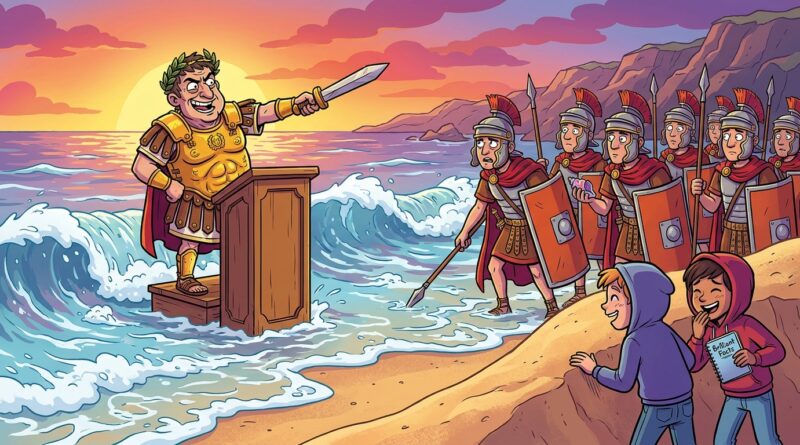
Instead of launching a normal military attack, Caligula reportedly drew up his soldiers facing the English Channel. Some accounts say he ordered them to attack the waves. Then he told them to gather seashells as “spoils of the sea.” In other words, his army came home with beach souvenirs.
You can see why kids love this story.
Did he really try to defeat a wave?
Maybe. Maybe not exactly in the cartoon version.
This is where it helps to be honest with kids. Ancient history is not always neat. Much of what we know about Caligula comes from writers who were not exactly his biggest fans. That means the story may have been exaggerated to make him look foolish.
Still, the shell-collecting part appears in more than one old source, which is why historians keep talking about it.
What historians think might have happened
There are a few ideas.
One is the simple version. Caligula really did stage a bizarre show of power at the shore, and his soldiers were left wondering what on earth was going on.
Another idea is that it was a symbol, not a literal war with the sea. Maybe he was celebrating Roman control over the coastline. Maybe the shells were trophies in a ceremonial act.
A third possibility is that there had been a canceled invasion of Britain, and the shell gathering was part of a face-saving display. Basically, “We came, we saw, we brought something home.” Not ideal, but emperors were big on appearances.
So yes, the famous version is silly. But the real lesson is even better. History can be weird, and the truth is sometimes messy.
Why kids remember this and forget the dates
Because this story has a picture built into it.
Roman soldiers in armor. A beach. An emperor making a dramatic speech. Waves doing what waves do. Then a troop of serious men picking up shells.
That image sticks.
It also gives kids permission to see history as human. Not every famous person was wise. Not every plan made sense. Sometimes the people in charge did things that would get laughed at in any school lunchroom today.
That is exactly why weird historical facts for kids work so well. They turn the past from “dead information” into a real story.
How to tell this story in under five minutes
If you want a quick dinner-table version, try this:
“A Roman emperor named Caligula took soldiers to the seashore. Ancient writers say he lined them up facing the water and had them collect seashells as trophies from the sea. So yes, history may include a man who tried to win a battle against waves.”
Then stop talking.
Let the kids react. They usually will.
Three easy follow-up questions
Use one of these:
- Do you think he was serious or putting on a show?
- If you had to bring home a “trophy” from the beach, what would count as winning?
- What is the weirdest order a ruler could give and still expect people to obey?
That turns one strange fact into a real conversation, not a mini lecture.
A simple trick for finding more stories like this
Start with one odd image. Then ask three things.
1. What happened?
Keep it short and clear.
2. Why might it have happened?
This adds mystery instead of just trivia.
3. What would you have done?
This pulls kids into the story.
You can use that same pattern with almost any unusual bit of history. If your family likes the gentler, surprising side of the past, History’s Strangest Calm Moments: True Stories Of Times The World Got Weirdly Peaceful is another nice example of how real history can be unusual without being grim.
Why this story still matters
It is funny, sure. But it also teaches a few useful things.
First, sources matter. Just because an ancient writer said something does not mean we should swallow it whole. Second, leaders are not always sensible. Third, memorable stories are often the best way to start learning.
That last one matters most for families.
If a child laughs at “the emperor who fought the ocean,” you now have an opening. From there, you can talk about Rome, Britain, propaganda, or why people in power sometimes do odd public stunts.
Not bad for one beach story.
At a Glance: Comparison
| Feature/Aspect | Details | Verdict |
|---|---|---|
| Main weird fact | Caligula reportedly had troops face the sea and collect seashells as trophies | Perfect hook for curious kids |
| Historical certainty | Ancient sources tell the story, but details may be exaggerated or symbolic | Best told as “reported history,” not absolute fact |
| Family value | Short, funny, true-ish in the historical record, and easy to discuss without getting too dark | Excellent screen-free conversation starter |
Conclusion
This is why strange little stories from the past are so useful. They give families something quick, true, and memorable to share without dragging everyone through a dry timeline. Caligula and his beachside “victory” feels like a cartoon, but it comes straight from real history, which makes it a great way to hook reluctant readers in under five minutes. Even better, it gives parents a repeatable formula. Find one odd fact, explain it in a few lines, then ask a question. That is often all it takes to turn a car ride, dinner, or bedtime into a fun history moment. And when kids are wired, bored, and one screen away from zoning out, having a stash of weird historical facts for kids can feel like a small parenting superpower.