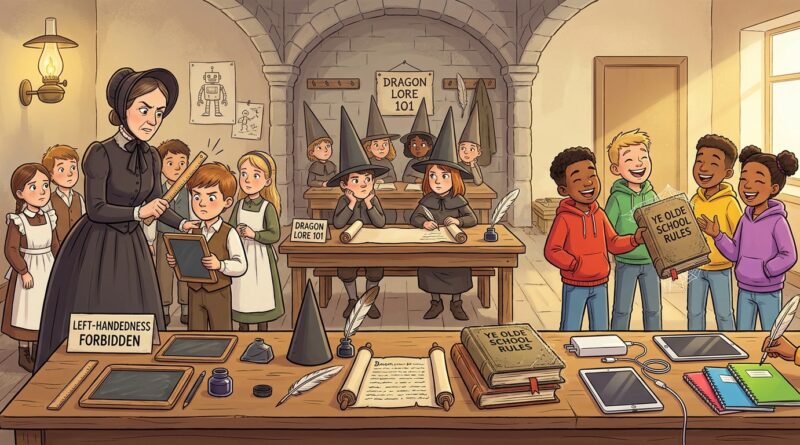
History’s Strangest School Rules: True Stories Of Banned Left Hands, Pointy Hats And Very Weird Classroom Laws
Getting kids interested in history can feel like dragging a backpack uphill. You want something more exciting than dates and dusty names, but a lot of “fun history” still sounds like schoolwork in a different font. That is where weird school rules in history for kids can really help. They are odd, funny, and just close enough to modern life that kids instantly have an opinion. Imagine telling a child that some students were once punished for writing with their left hand, forced to wear a pointy “dunce” cap, or expected to sit ramrod straight for hours in silence. Suddenly history is not far away anymore. It is personal. It sparks the best kind of question. “Wait, they did what?” That reaction is gold. It opens the door to talk about fairness, kindness, power, and how school has changed, all without making it feel like a lesson.
⚡ In a Hurry? Key Takeaways
- Some of history’s strangest school rules were very real, including punishing left-handed students, using dunce caps, and enforcing extreme silence and posture.
- Use these stories as quick “What would you do?” conversations at dinner or in the car to make history feel alive.
- The goal is not to shock kids, but to help them think about fairness, empathy, and how rules reflect the values of their time.
Why weird old school rules work so well with kids
Kids do not always care when a king was born. They do care when another kid from long ago got in trouble for using the “wrong” hand.
That is the trick. The best history stories connect to everyday life. School is already a big part of a child’s world, so strange classroom laws feel immediate and real.
They also invite argument, which is useful. A child can compare the past to their own classroom rules and start asking bigger questions. Was it fair? Why did adults think that was a good idea? What rules today might seem silly 100 years from now?
True stories of weird school rules in history for kids
1. Left-handed children were forced to switch hands
For a long time in parts of Europe, America, and elsewhere, being left-handed was treated as a problem that needed fixing. In many schools, children were pushed, trained, or punished into writing with their right hand.
Why? Old beliefs played a big part. In some cultures, the left side was linked with bad luck or bad behavior. Teachers often thought using the right hand was more proper, neat, and disciplined.
For kids today, this sounds absurd. For many children back then, it was stressful and humiliating.
Good question to ask: If everyone around you said a normal part of you was wrong, how would that feel?
2. The pointy dunce cap was meant to shame students
The dunce cap is one of the most famous strange school punishments in history. A child who was seen as slow, distracted, or badly behaved might be made to wear a tall pointed hat in front of the class.
The point was public embarrassment. It marked a child as foolish.
That is worth pausing on. Many old school rules were not just about order. They were about shame.
This is a good place to talk with kids about the difference between correction and humiliation. One helps you improve. The other just hurts.
3. Silence could be treated like a serious rule, not a polite suggestion
In many older classrooms, students were expected to sit quietly for long stretches with little movement and almost no chatting. Speaking out of turn could bring punishment.
Teachers were often managing huge classes with very few tools, so strict silence became the system.
To a modern child, that can sound impossible. No whispering. No calling out. Sometimes not even turning around.
Ask: Would you learn better in total silence, or would you just feel nervous?
4. Posture was policed like behavior
Some schools treated slouching almost like a moral failure. Students were expected to sit perfectly upright, hold books a certain way, and present themselves with constant physical control.
This was tied to older ideas about discipline and character. Good posture was seen as proof of good habits and good values.
There is a kernel of common sense in there, of course. But in some classrooms, the rule became extreme.
Kids often find this one funny. Then they try sitting perfectly still for two minutes and quickly decide history was tougher than it looked.
5. Harsh memorization ruled the room
Many past classrooms put heavy focus on repeating facts out loud, often word for word. Understanding was not always the main goal. Obedience and accurate recall mattered more.
That could mean reciting long passages, multiplication tables, grammar rules, or religious texts in front of everyone.
Some kids were great at it. Others froze.
This helps children see that school has changed not just in rules, but in what adults think learning should look like.
6. Physical punishment was once considered normal
This is the least funny part, but it matters. In many places and time periods, schools used physical punishment for talking, fidgeting, mistakes, lateness, or disobedience.
You do not need to go into upsetting detail with younger kids. The bigger point is simple. Adults in the past often believed fear built character.
That opens up an important discussion about how ideas of discipline change over time, and why.
What these odd rules actually teach
Weird old classroom laws are fun, but they are not just trivia. They help kids notice something bigger. Rules are not random. They show what a society cares about.
If a school punished left-handedness, that says something about conformity. If a class used public shame, that says something about authority. If silence mattered more than curiosity, that says something about the kind of adults children were expected to become.
That is pretty deep thinking, and you can get there from one bizarre story.
Easy ways parents and teachers can use these stories
Try a two-minute role-play
Say, “You are a student in 1890. The teacher tells you to stop writing with your left hand. What do you say?”
Kids love pretending, especially when the rule is clearly unfair.
Use a simple compare-and-contrast question
Ask, “Which school rule today would seem weird to kids from 200 years ago?”
That flips the conversation and gets children thinking about their own world as history-in-progress.
Let them rank the strangest rules
Give them three choices. Left-hand ban. Dunce cap. Total silence. Then ask them to rank each one from “most unfair” to “least unfair.”
You will usually get strong opinions fast.
Connect one strange story to another
If your child likes odd bits of history, pair this topic with unusual discoveries made by young people. History’s Strangest Lost‑And‑Found: True Stories Of Kids Who Accidentally Discovered Ancient Treasures works well because it keeps the same sense of surprise while showing that children are not just bystanders in history. Sometimes they stumble right into it.
How to keep it age-appropriate
With younger kids, stick to the surprising and relatable parts. The left-hand rule. The pointy hat. The no-talking rule.
With older kids, you can dig more into power, punishment, disability, fairness, and how schools were shaped by religion, class, and social expectations.
You do not have to turn every story into a lecture. One good question is enough.
Why kids remember the weird stuff
Because it feels human. A strange school rule is not just a fact. It is a small drama.
A child can picture it. They can react to it. They can imagine themselves in it.
That is often the difference between information that vanishes by bedtime and information that sticks for years.
At a Glance: Comparison
| Feature/Aspect | Details | Verdict |
|---|---|---|
| Shock factor | Rules like banning left-handed writing or using dunce caps are instantly surprising to modern kids. | Excellent hook for history conversations |
| Learning value | These stories open discussion about fairness, authority, empathy, and how social values change over time. | Much deeper than simple trivia |
| Ease of use | Works well in short chats, car rides, dinner questions, or quick classroom warm-ups without worksheets. | Very parent- and teacher-friendly |
Conclusion
Weird old school rules hit a sweet spot. They are wild enough to compete with fast, snackable trivia, but familiar enough to feel personal. That makes them perfect for family conversation. A ban on left hands, a pointy hat, or a no-talking rule can turn into a real talk about kindness, courage, and what makes a rule fair. Best of all, you do not need a lesson plan, a worksheet, or more screen time. Just one strange story and one good question. Sometimes that is all it takes to make history feel less like homework and more like a story kids actually want to hear.